Condensate Load from Heating Liquid Continuous Formula |
||
| \( m_c \;=\; 1000 \cdot c_l \cdot SG_l \cdot Q_l \cdot \dfrac{ T_o - T_i }{ L_s } \) | ||
| Symbol | English | Metric |
| \( m_c \) = condensate load | \(lbm\) | \(kg\) |
| \( Q_l \) = liquid flow rate | \(ft^3 \;/\; sec\) | \(m^3 \;/\; s\) |
| \( L_s \) = steam latent heat | \(Btu \;/\; lbm\) | \(kJ \;/\; kg\) |
| \( SG_l \) = liquid specific gravity | \(dimensionless\) | \(dimensionless\) |
| \( c_l \) = liquid specific heat | \(Btu \;/\; lbm-F\) | \(J \;/\; kg-K\) |
| \( T_i \) = liquid inlet temperature | \(^\circ F\) | \(^\circ K\) |
| \( T_o \) = liquid outlet temperature | \(^\circ F\) | \(^\circ K\) |
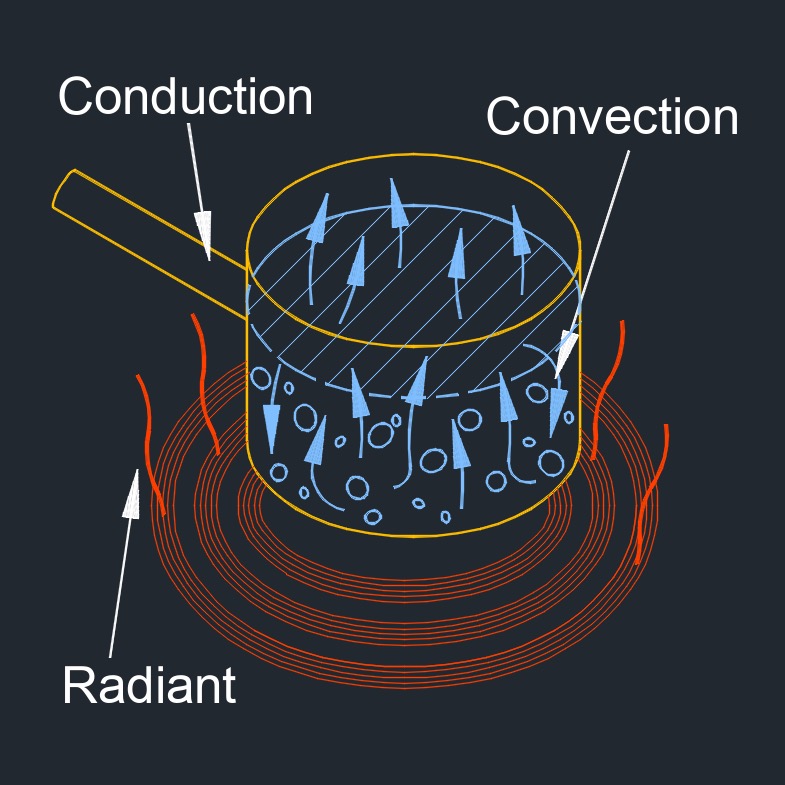 Condensate load from heating a liquid is the amount of condensate (water in liquid form) that is produced when a vapor or gas (often steam) used to heat another liquid condenses back into a liquid state after transferring its heat. Remember, this is a simplified explanation. Real-world scenarios might involve more complex thermodynamics, equipment efficiency, and system losses.
Key Points about Condensate Load from Heating Liquid
Heating Process - When you heat a liquid (like water or another substance), you typically use a heat source like steam. This steam gives off its heat to the liquid being heated.
Condensation - As the steam transfers its heat to the liquid, it cools down, loses energy, and turns back into water droplets or liquid water.
Condensate Load - It is the volume or mass of this liquid water formed from the steam. It's important in systems where steam is used for heating because:
Temperature Difference - The greater the temperature difference between the steam and the liquid being heated, the more condensate you'll produce because more steam will condense.
Surface Area - More surface area for heat exchange means more efficient condensation, hence potentially more condensate.
Steam Pressure - Higher pressure steam will condense to produce more condensate when it cools to the same temperature as lower pressure steam.