Allowable bearing capacity, abbreviated as \( q_a \), is the maximum contact pressure that may be applied to soil at the foundation level without causing shear failure or excessive settlement that would impair structural performance. It is a design parameter used in geotechnical engineering to ensure both safety and serviceability of foundations. Unlike ultimate bearing capacity, which represents the theoretical stress at which shear failure occurs in the supporting soil mass, allowable bearing capacity incorporates a margin of safety and practical performance limits.
Allowable Bearing Capacity formula |
||
|
\( q_a \;=\; \dfrac{ q_u }{ FS }\) (Allowable Bearing Capacity) \( q_u \;=\; q_a \cdot FS \) \( FS \;=\; \dfrac{ q_u }{ q_a }\) |
||
| Symbol | English | Metric |
| \( q_a \) = Allowable Bearing Capacity | \(lbf\;/\;in^2\) | \(Pa\) |
| \( q_u \) = Ultimate Bearing Capacity (Stress at Shear Failure) | \(lbf\;/\;in^2\) | \(Pa\) |
| \( FS \) = Factor of Safety | \(dimensionless\) | \(dimensionless\) |
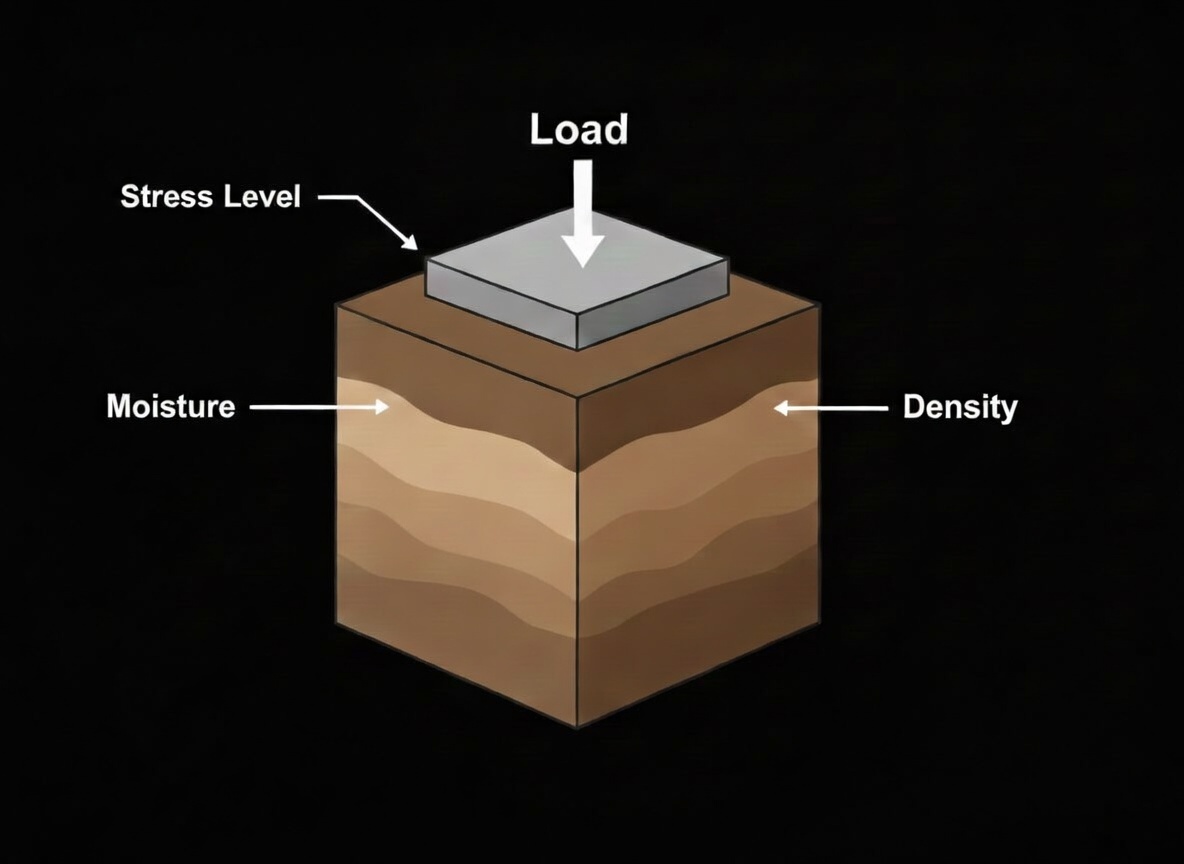 For shallow foundations, the ultimate bearing capacity is commonly determined using classical bearing capacity theory. The allowable bearing capacity based on shear strength is calculated by dividing the ultimate bearing capacity by an appropriate factor of safety. This reduction accounts for uncertainties in soil properties, subsurface variability, loading conditions, and analytical assumptions. However, allowable bearing capacity is not governed solely by shear failure. In many cases, particularly in compressible soils, the limiting criterion is settlement rather than shear strength. Even if the soil does not reach shear failure, excessive total or differential settlement can cause structural distress.