Plastic limit, abbreviated as \(PL\), a dimensionless number, is a fundamental index property of fine-grained soils defined within the framework of the Atterberg limits. It represents the water content at which a soil transitions from a plastic, moldable state to a semi-solid, brittle state. In practical terms, it is the lowest moisture content at which the soil can be deformed plastically without cracking.
Plastic Limit Formula |
||
|
\( PL \;=\; \dfrac{ W_w }{ W_s } \cdot 100 \) (Plastic Limit) \( W_w \;=\; \dfrac{ PL \cdot W_s }{ 100 } \) \( W_s \;=\; \dfrac{ 100 \cdot W_w }{ PL } \) |
||
| Symbol | English | Metric |
| \( PL \) = Plastic Limit | \(dimensionless\) | \(dimensionless\) |
| \( W_w \) = Weight of Water | \(lbm\) | \(kg\) |
| \( W_s \) = Weight of Oven-dried Soil | \(lbm\) | \(kg\) |
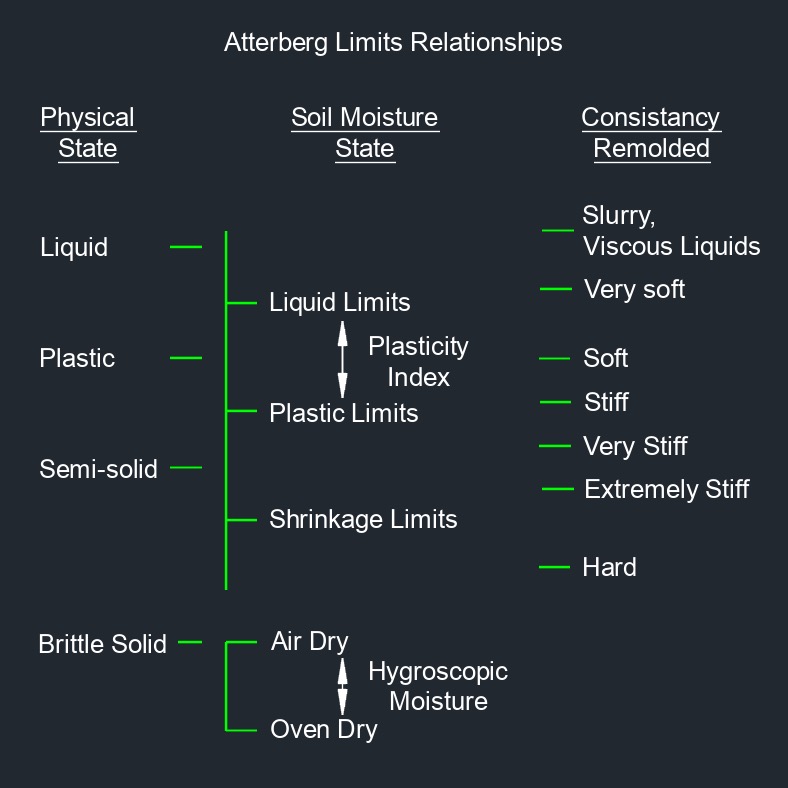
The plastic limit is determined in the laboratory by repeatedly rolling a soil sample into threads of approximately 3 mm (1/8 inch) in diameter. As the soil dries during this process, a point is reached where the threads begin to crumble at that specified diameter. The moisture content at which this crumbling consistently occurs is defined as the plastic limit. This procedure is standardized (for example, by ASTM D4318), ensuring repeatability and comparability across tests.
The plastic limit is essential because it helps characterize the consistency and workability of cohesive soils, particularly clays and silts. It forms one of the two boundaries used to compute the plasticity index, which is the numerical range over which the soil remains plastic. Soils with higher plastic limits generally require more water to maintain plastic behavior, indicating stronger interparticle cohesion and often greater clay content. This parameter is therefore critical in assessing soil behavior in earthworks, foundation design, and slope stability, especially where moisture variations are expected.