Liquid limit, abbreviated as \(LL\), a dimensionless number, is a fundamental index property of fine-grained soils defined as the water content at which the soil transitions from a plastic state to a liquid state. At this boundary, the soil loses its ability to sustain shear stresses without undergoing continuous deformation and begins to behave as a viscous fluid rather than a deformable solid. In practical terms, it represents the moisture condition at which the soil just begins to flow under very small applied forces.
Liquid Limit Formula |
||
|
\( LL \;=\; w_n \cdot \left(\dfrac{ N }{ 25 } \right) ^{0.121} \) (Liquid Limit) \( w_n \;=\; LL \cdot \left(\dfrac{ 25 }{ N } \right) ^{0.121} \) \( N \;=\; 25 \cdot \left(\dfrac{ LL }{ w_n } \right) ^{ \frac{ 1}{0.121} } \) |
||
| Symbol | English | Metric |
| \( LL \) = Liquid Limit | \(dimensionless\) | \(dimensionless\) |
| \( w_n \) = Natural Water Content (Moisture Content) | \(dimensionless\) | \(dimensionless\) |
| \( N \) = Number of Blows Causing Closures of the Standard Groves | \(dimensionless\) | \(dimensionless\) |
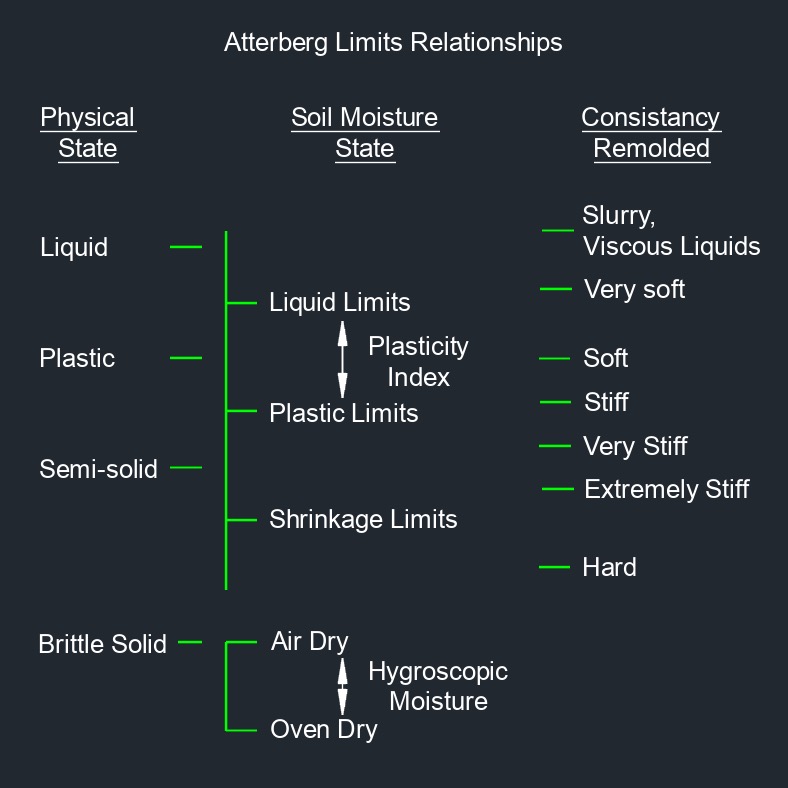
The liquid limit is determined in the laboratory using standardized procedures, most commonly the Casagrande cup method or the cone penetrometer method. In the Casagrande method, the liquid limit corresponds to the water content at which a groove in a soil sample closes over a specified distance (12.7 mm or 1/2 inch) under exactly 25 blows of the cup. This criteria is empirical but has been widely validated and standardized (e.g., ASTM D4318), making it a consistent reference point for comparing soils.
The liquid limit is a parameter in soil classification systems such as the Unified Soil Classification System (USCS) and AASHTO. It is also used in conjunction with the plastic limit to define the plasticity index, which quantifies the range of water contents over which the soil exhibits plastic behavior. High liquid limit values generally indicate soils with high clay content and high compressibility, low shear strength at high moisture contents, and significant volume change potential. Conversely, low liquid limit values are associated with silts or soils with lower plasticity and reduced sensitivity to moisture changes.