Speed of light in a vacuum, abbreviated as \(c\), is a universal physical constant that is exactly equal to 299,792,458 metres per second. This value is defined precisely by international agreement within the International System of Units (SI). The metre itself is defined as the exact distance that light travels in vacuum during a time interval of 1/299,792,458 of a second, making the speed of light an exact fixed constant rather than a measured approximation.
Speed of Light formula |
||
|
\( c \;=\; \lambda \cdot f \) (Speed of Light) \( \lambda \;=\; \dfrac{ c }{ f }\) \( f \;=\; \dfrac{ c }{ \lambda }\) |
||
| Symbol | English | Metric |
| \( c \) = Speed of Light (See Physics Constant) | \(ft \;/\; sec\) | \(m \;/\; s\) |
| \( \lambda \) (Greek symbol \lambda) = Wavelength | \(ft\) | \(m\) |
| \( f \) = Frequency | \(Hz\) | \(Hz\) |
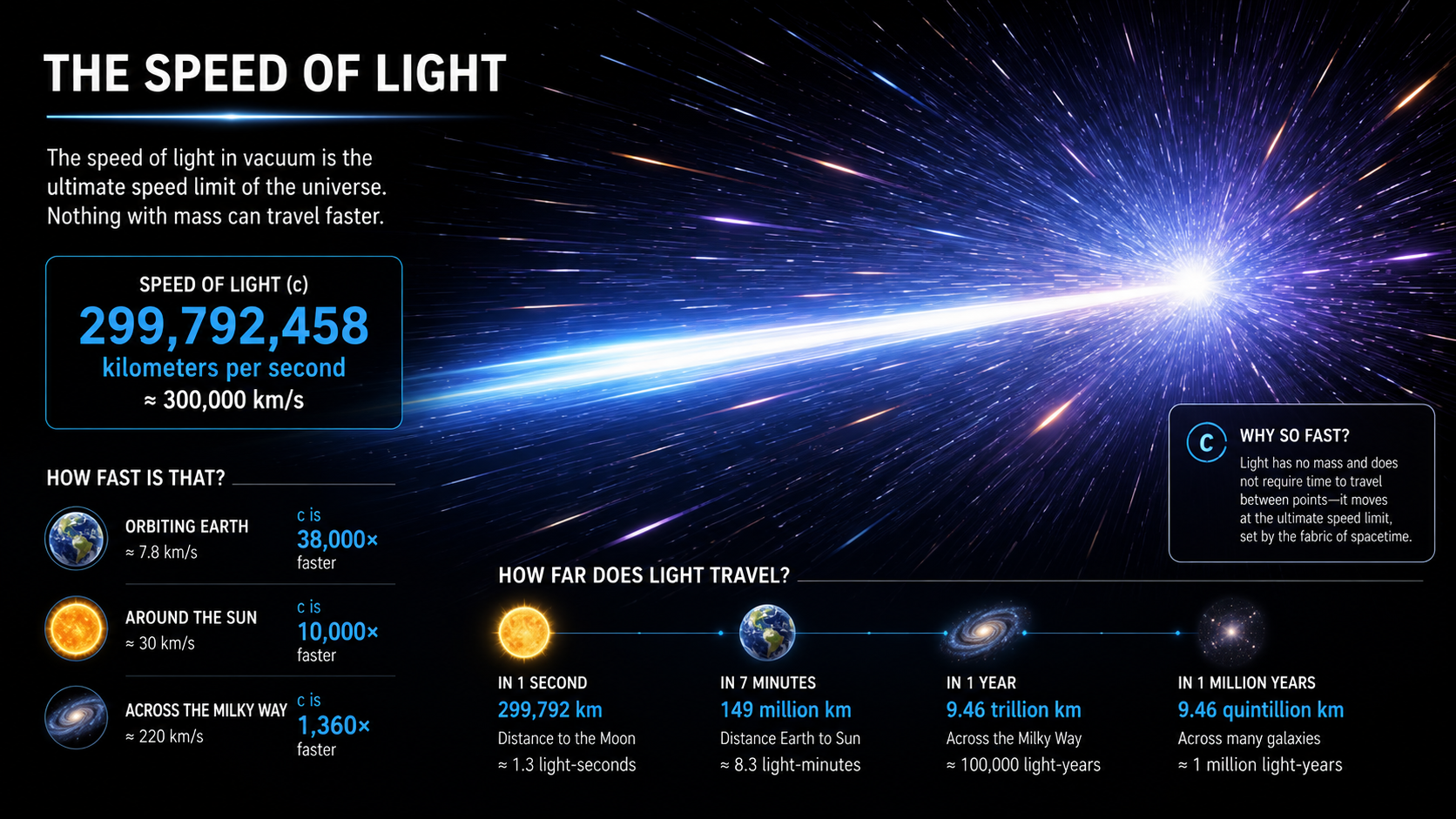
This definition was established in 1983 by the General Conference on Weights and Measures to tie the unit of length to the speed of light and the definition of the second, which is based on the hyperfine transition frequency of caesium-133 atoms. As a result, c serves as the foundation for the metre in the SI system, ensuring consistency in measurements across physics and engineering. In vacuum, light and all other electromagnetic waves propagate at this constant speed, independent of the motion of the source or observer, a principle central to Einstein's theory of special relativity.
The speed of light is significantly slower in other media, such as air, water, or glass, due to interactions with matter, but the vacuum value remains the fundamental limit. No information or matter can travel faster than c in vacuum according to established physical laws.