
Aerospace
Mechanical, Aerospace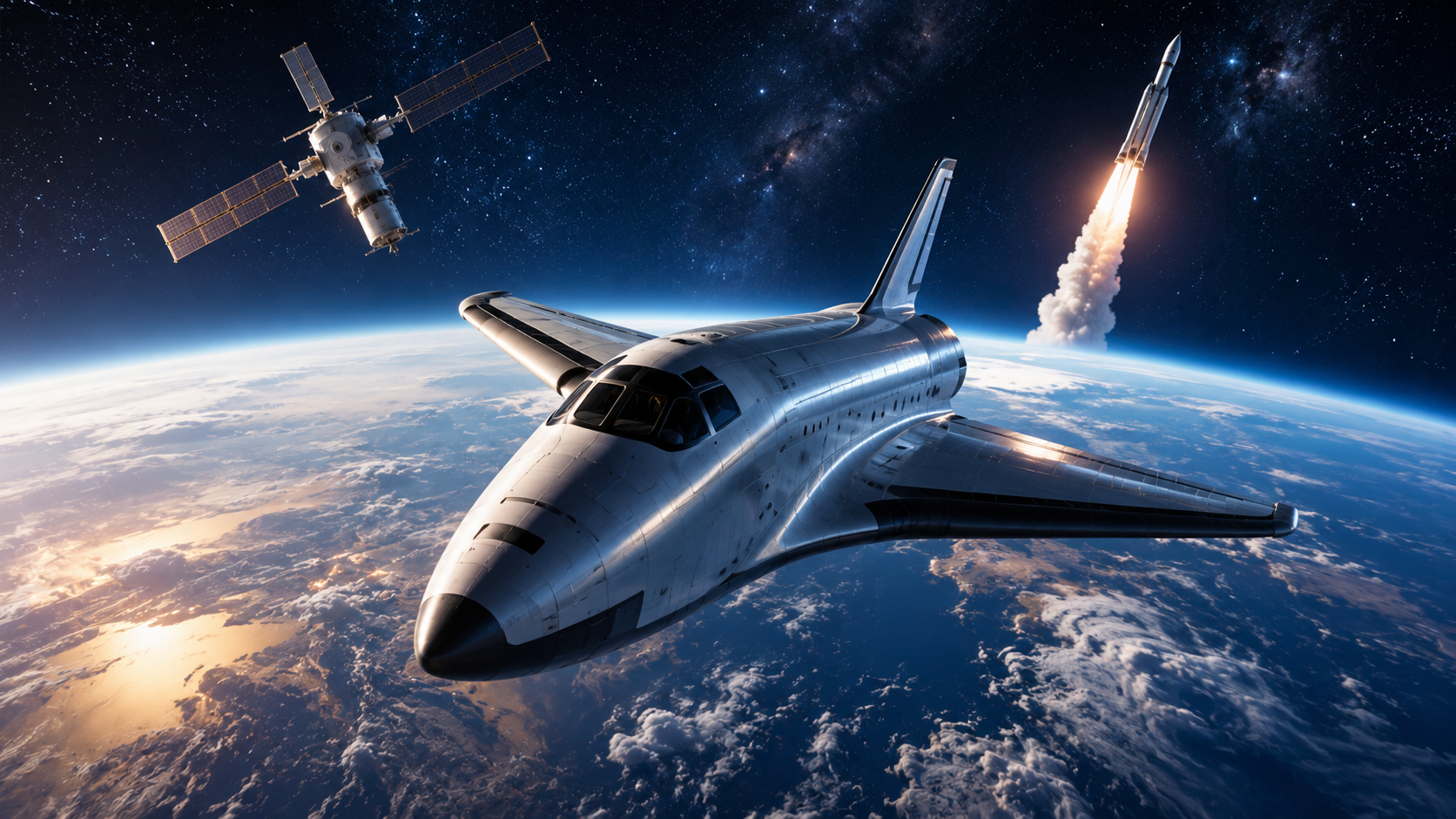 Aerospace spans from the lower layers of Earth’s atmosphere to the vacuum of outer space, together with scientific and engineering practices required to operate within an unbroken transition. It is not merely a convenient combination of “air” and “space,” but a concept grounded in the recognition that flight regimes from subsonic aircraft to orbital spacecraft can be analyzed within a common theoretical framework. This governing equations of motion, energy conservation, and momentum transfer remain valid across both atmospheric and exoatmospheric conditions, even though the forces and environmental parameters change significantly.
Aerospace treats atmospheric fligh and spaceflight as coupled subdomains. The distinction between them is operational rather than fundamental, aeronautics deals with vehicles supported by aerodynamic forces in a fluid medium, whereas astronautics addresses motion in regimes where continuum assumptions break down and orbital mechanics governed by gravitational fields and inertial motion predominates. The transition between these regimes is not defined by a single universally fixed boundary, but is often associated with the Kármán line, approximately 100 kilometers above mean sea level, where aerodynamic lift becomes insufficient to sustain conventional flight.
Aerospace encompasses flight capable systems, vehicle configuration, propulsion (air-breathing and rocket-based), structural design under extreme loads and temperatures, guidance, navigation, and control, and mission architecture. It also includes the interaction between vehicles and their environments, such as aerodynamic heating during high-speed atmospheric entry or microgravity effects in orbit. The term signifies a rigorously defined, interdisciplinary domain that unifies the physics of motion and energy across two distinct but contiguous environments, enabling the systematic development of technologies for transportation, observation, communication, and exploration beyond the constraints of the Earth’s surface.
| Science |
| Applied Science |
| Engineering |
| Mechanical Engineering |
| Aerospace |
Aerospace Branches
Aeronautical (Aeronautics) - Focuses on the theory, technology, and practice of flight within Earth's atmosphere, including aircraft, helicopters, and other vehicles propelled by air-breathing engines.
Astronautical (Astronautics) - Focuses on the science and technology of spacecraft, rockets, satellites, launch vehicles, and other vehicles operating outside Earth's atmosphere, typically propelled by rocket engines.