Wave speed, abbreviated as \(v\), also called wave velocity, is the rate at which a wave propagates through a medium or through space. It describes how fast the disturbance or wave pattern travels from one location to another, not how fast the individual particles of the medium move. In mechanical waves, such as sound waves in air or waves traveling along a stretched string, the particles of the medium oscillate about their equilibrium positions while the wave itself moves through the medium. In electromagnetic waves, such as visible light or radio waves, the wave consists of oscillating electric and magnetic fields and does not require a material medium to propagate through a vacuum.
Wave Velocity Formula |
||
|
\( v \;=\; f \cdot \lambda \) (Wave Velocity) \( f \;=\; \dfrac{ v }{ \lambda }\) \( \lambda \;=\; \dfrac{ v }{ f }\) |
||
| Symbol | English | Metric |
| \( v \) = Wave Velocity | \(ft\;/\;sec\) | \(m\;/\;s\) |
| \( f \) = Frequency | \(Hz\) | \(Hz\) |
| \( \lambda \) (Greek symbol lambda) = Wavelength | \(ft\) | \(m\) |
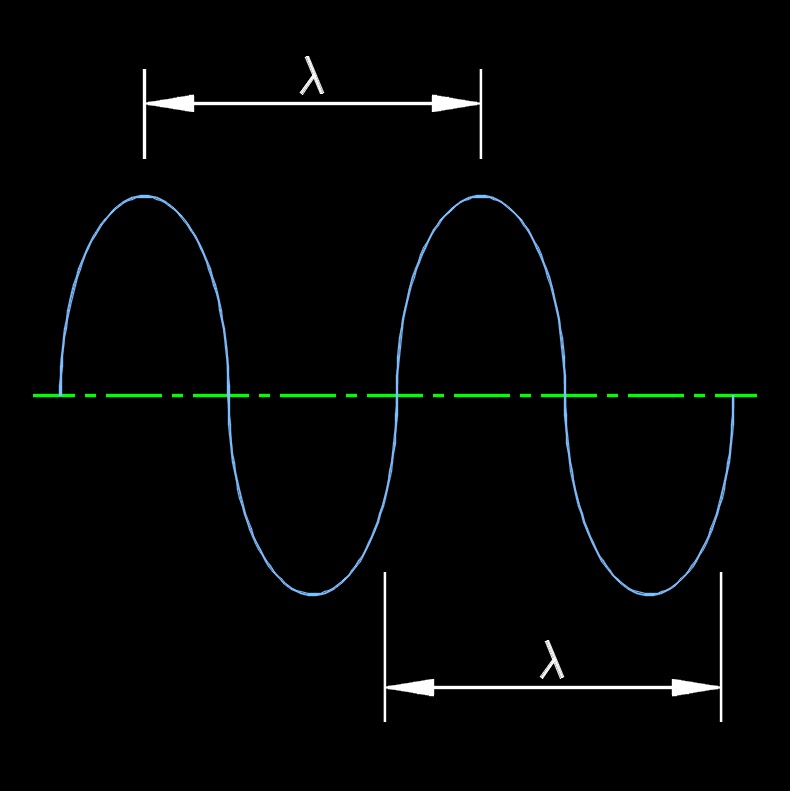
This equation states that the speed of a wave equals the number of wave cycles passing a point each second multiplied by the length of each cycle. If the frequency increases while the wave speed remains constant, the wavelength decreases proportionally. Likewise, if the wavelength increases, the frequency decreases proportionally.
Wave velocity is determined primarily by the properties of the medium through which the wave travels. For mechanical waves, these properties generally include the medium's elasticity and inertia. A medium that is more resistant to deformation and less massive tends to transmit waves more rapidly. For example, sound travels much faster in steel than in air because steel is significantly stiffer, even though it is denser. In a stretched string, the wave velocity depends on the string tension and its mass per unit length. In fluids, the speed of sound depends on the fluid's bulk modulus and density.
For electromagnetic waves, the situation is different because they do not require a material medium. In a vacuum, all electromagnetic waves travel at the constant speed of light which has the exact value of 299,792,458 m/s. When electromagnetic waves enter a material such as glass or water, they travel more slowly because they interact with the atoms and molecules of the material. The reduction in speed is described by the material's refractive index.