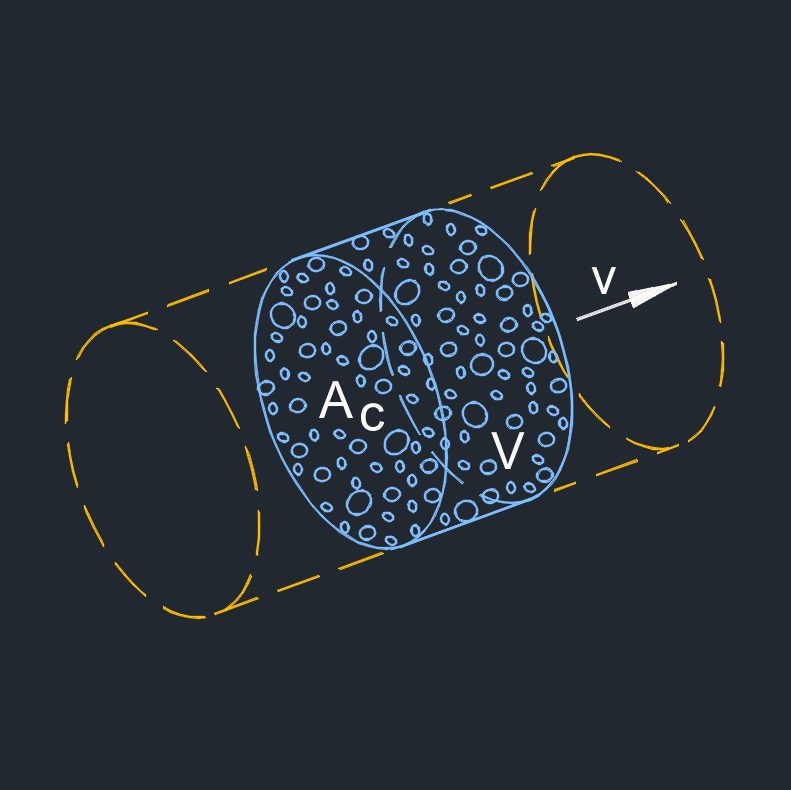
Steam flow rate through piping is the amount of steam that passes through a pipe within a specific time period. This flow rate through depends on various factors including the valve and fitting sizes, pipe size, the pressure, pressure drop and temperature of the steam, the length and configuration of the piping system, and the demand of the steam using equipment or processes.
steam Flow Rate through Piping formula |
||
|
\( Q_s \;=\; 3600 \cdot \pi \cdot \dfrac{ v_s }{ \upsilon } \cdot \left( \dfrac{ d }{ 24 } \right) ^2 \) (Steam Flow Rate Through Piping) \( v_s \;=\; \dfrac{ 0.16 \cdot Q_s \cdot v }{ \pi \cdot d^2 } \) \( \upsilon \;=\; \dfrac{ 6.25 \cdot \pi \cdot v_s \cdot d^2 }{ Q_s } \) \( d \;=\; \sqrt{ \dfrac{ Q_s \cdot \upsilon }{ 6.25 \cdot \pi \cdot v_s } }\) |
||
| Symbol | English | Metric |
| \( Q_s \) = Steam Flow Rate | \(lb\;/\;hr\) | - |
| \( \pi \) = Pi | \(3.141 592 653 ...\) | - |
| \( v_s \) = Steam Velocity | \(ft\;/\;sec\) | - |
| \( \upsilon \) (Greek symbol upsilon) = Steam Specific Volume | \(ft^3\;/\;lbm\) | - |
| \( d \) = Pipe Inside Diameter | \(in\) | - |
 For saturated steam, the density can be obtained from the steam pressure or saturation temperature using appropriate steam-property data. For superheated steam, both pressure and temperature are required to determine its specific volume or density. If wet steam is present, the steam quality (dryness fraction) must also be considered because liquid water carried with the steam changes the mixture properties and can affect piping performance.