
Acoustics
Laws of Physics, Physics, Acoustics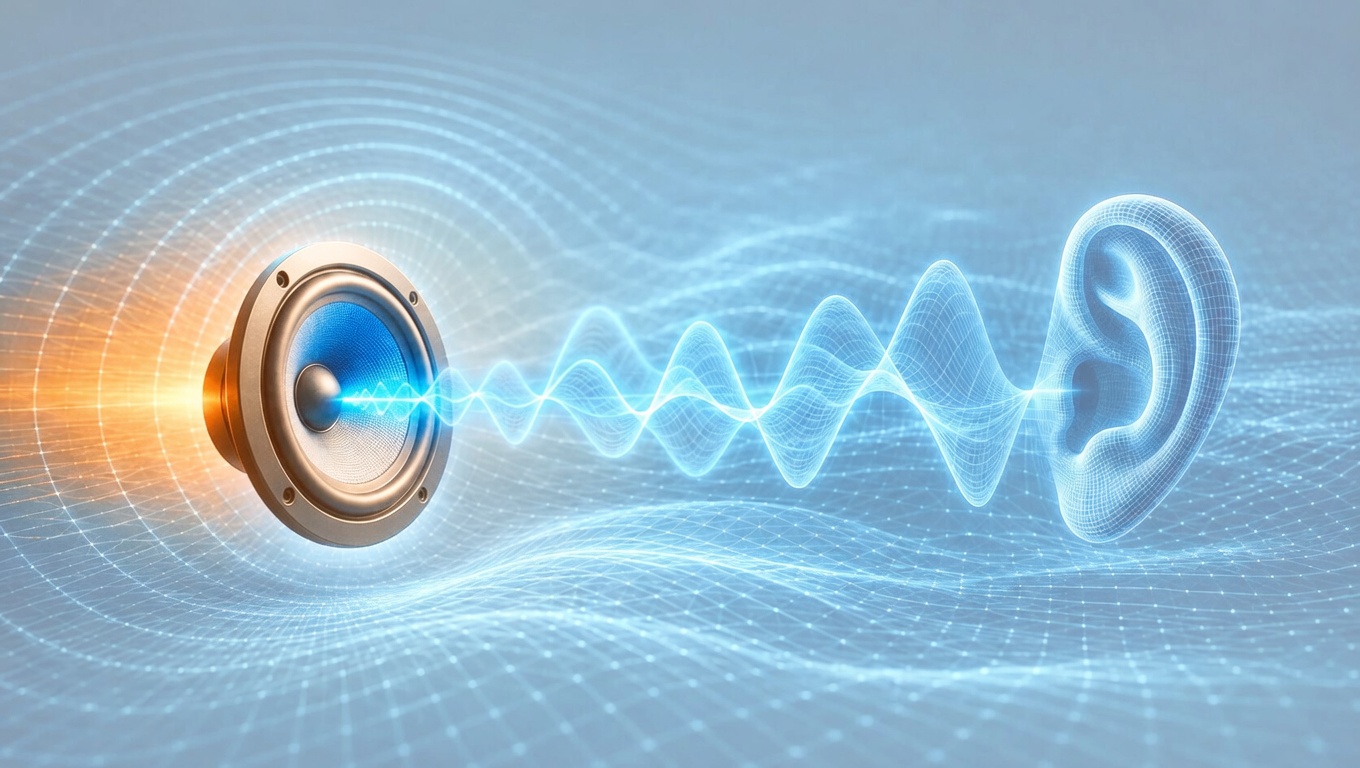 Acoustics is concerned with the generation, propagation, and reception of sound, as well as the effects of sound on materials, environments, and living organisms. It studies mechanical waves that propagate through a medium such as air, gases, liquids, and solids, via oscillations of pressure, particle displacement, or stress. These waves are governed by physical principles, including conservation laws and continuum mechanics, and are typically described using parameters such as frequency, wavelength, amplitude, and wave speed. The human auditory system is generally within the frequency range of about 20 Hz to 20 kHz.
The field encompasses both fundamental theory and applied analysis. On the theoretical side, acoustics relies on mathematical formulations derived from fluid dynamics and elasticity theory to describe wave behavior, including reflection, refraction, diffraction, and absorption. On the applied side, it addresses practical problems such as architectural acoustics (how sound behaves in enclosed spaces), environmental noise control, underwater acoustics, electroacoustics (conversion between electrical signals and sound), and bioacoustics (sound production and perception in biological systems). Across these disciplines, the objective is to quantitatively understand how sound is produced, how it travels through different media, and how it interacts with boundaries and receivers.
| Science |
| Natural Science |
| Physics |
| Classical Physics |
| Acoustics |
Acoustics Branches
Oceanography - Study of sound propagation and use in ocean environments.
Animal Bioacoustics - Study of sound production, reception, and effects in animals.
Architectural - Design and control of sound in buildings and enclosed spaces.
Biomedical (or Biomedical Ultrasound/Bioresponse to Vibration) - Application of sound and ultrasound in medical diagnosis, therapy, and biological research.
Engineering - Development of transducers, devices, and systems involving sound.
Musical - Scientific study of music, instruments, and sound production in musical contexts.
Noise (Environmental Noise) - Control, measurement, and effects of unwanted sound.
Physical - Fundamental study of sound wave propagation, generation, and interaction in media.
Psychological and Physiological - Perception and biological processing of sound by humans and animals.
Signal Processing - Analysis, manipulation, and enhancement of acoustic signals.
Speech Communication - Production, transmission, and perception of speech.
Structural and Vibration - Interaction of sound with structures and vibrational phenomena.
Underwater - Sound propagation, detection, and applications in underwater environments.