
Chemistry
Laws of Gas, Laws of Physics, Chemical Elements, Laws of Chemistry, Physical Chemistry, Natural Science, Inorganic Chemistry, Organic Chemistry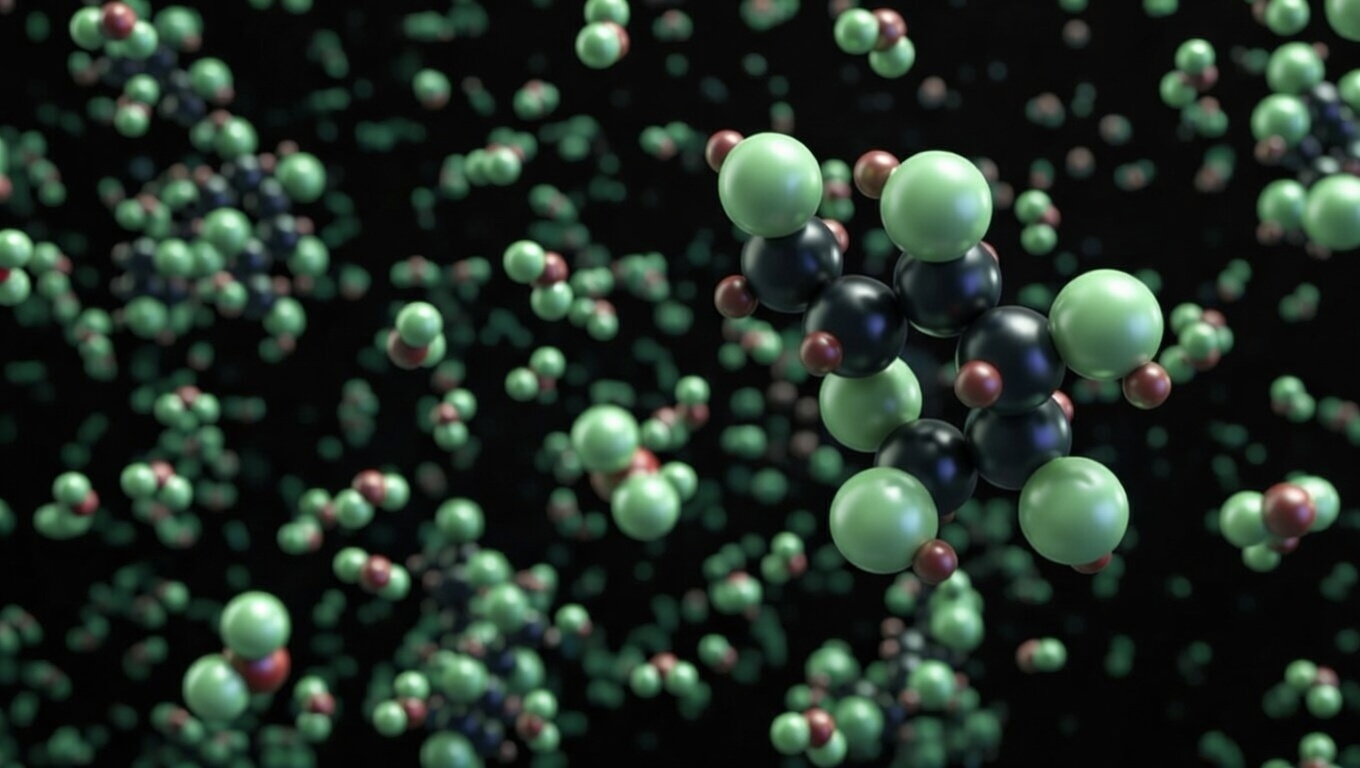 Chemistry studies the composition, structure, properties, and transformations of matter. Matter consists of substances made from atoms and molecules, and chemistry focuses on understanding how these particles are arranged and how they interact. The field examines the identities of substances, the quantitative relationships between their components, and the physical and chemical properties that arise from their atomic and molecular structures. These properties include measurable characteristics such as mass, density, reactivity, phase behavior, and energy changes during interactions. The field is grounded in experimentally verified principles from thermodynamics, quantum mechanics, and kinetics, which explain why substances behave in specific ways.
A central focus of chemistry is the study of chemical reactions, which are processes in which substances (reactants) are transformed into different substances (products) through the breaking and formation of chemical bonds. These transformations follow established physical laws, including the conservation of mass and the conservation of energy. Chemistry therefore seeks to explain how and why substances combine, separate, or change form under different conditions such as temperature, pressure, concentration, and the presence of catalysts.
| Science |
| Natural Science |
| Chemistry |
Chemistry operates across multiple scales of matter. At the atomic and molecular level, it examines electrons, chemical bonding, molecular geometry, and intermolecular forces. At larger scales, it studies bulk properties and the behavior of materials, solutions, and mixtures. The discipline uses quantitative measurement and theoretical models to describe and predict the behavior of substances. Fundamental principles such as atomic theory, thermodynamics, quantum mechanics, chemical kinetics, and equilibrium provide the framework for understanding chemical systems.
Chemistry Branches
Principles of Chemistry
Atomic Theory of Matter - This principle states that all ordinary matter is composed of atoms, which are the smallest units of chemical elements that retain the chemical identity of those elements. Chemical behavior is largely governed by the arrangement and interactions of electrons.
Periodic Law - States that the chemical and physical properties of elements vary periodically when the elements are arranged according to increasing
Chemical Bonding - Atoms combine to form molecules and compounds through interactions involving electrons. The principal types of chemical bonding are ionic bonding, covalent bonding, and metallic bonding.
Conservation of Mass - A chemical principle established experimentally. It states that in an ordinary chemical reaction, matter is neither created nor destroyed. The total mass of reactants equals the total mass of products.
Principle of Definite Proportions - States that a chemical compound always contains the same elements in the same fixed ratio by mass. Another related principle is the law of multiple proportions, which states that when two elements form more than one compound, the masses of one element that combine with a fixed mass of the other are related by small whole number ratios.
Thermodynamics - Thermodynamics studies energy transformations associated with physical and chemical processes. The first law of thermodynamics states that energy is conserved, it can change forms but cannot be created or destroyed. The second law states that natural processes tend to increase the total entropy of a system and its surroundings. Chemical reactions are influenced by changes in enthalpy, entropy, and free energy. These principles determine whether reactions are energetically favorable and how energy is transferred as heat or work.
Chemical Kinetics - It concerns the rates of chemical reactions and the factors that influence those rates, including temperature, concentration, surface area, catalysts, and activation energy. The collision theory of reactions states that reactant particles must collide with sufficient energy and proper orientation for a reaction to occur. Catalysts increase reaction rates by lowering the activation energy without being consumed in the overall reaction.
Chemical Equilibrium - Describing reversible reactions in which forward and reverse reaction rates become equal. At equilibrium, concentrations of reactants and products remain constant over time, although reactions continue microscopically. The equilibrium position can shift in response to changes in concentration, pressure, or temperature.
Acid Base Chemistry - Acid base reactions involve proton transfer or electron pair interactions and are essential in biological systems, industrial chemistry, environmental chemistry, and analytical chemistry. The pH scale quantitatively describes acidity and basicity.
Oxidation Reduction - Commonly called redox chemistry, describe reactions involving electron transfer. Oxidation refers to the loss of electrons, while reduction refers to the gain of electrons. Redox reactions are fundamental to processes such as combustion, corrosion, electrochemistry, respiration, and photosynthesis.
Relationship between Structure and Properties - The physical and chemical properties of substances depend directly on their atomic and molecular structures. Molecular geometry, bond polarity, crystal arrangement, and electronic structure determine characteristics such as melting point, conductivity, hardness, solubility, color, and reactivity.
These principles collectively form the framework of chemistry. They explain how matter behaves across scales ranging from subatomic particles to complex biological systems and industrial processes.