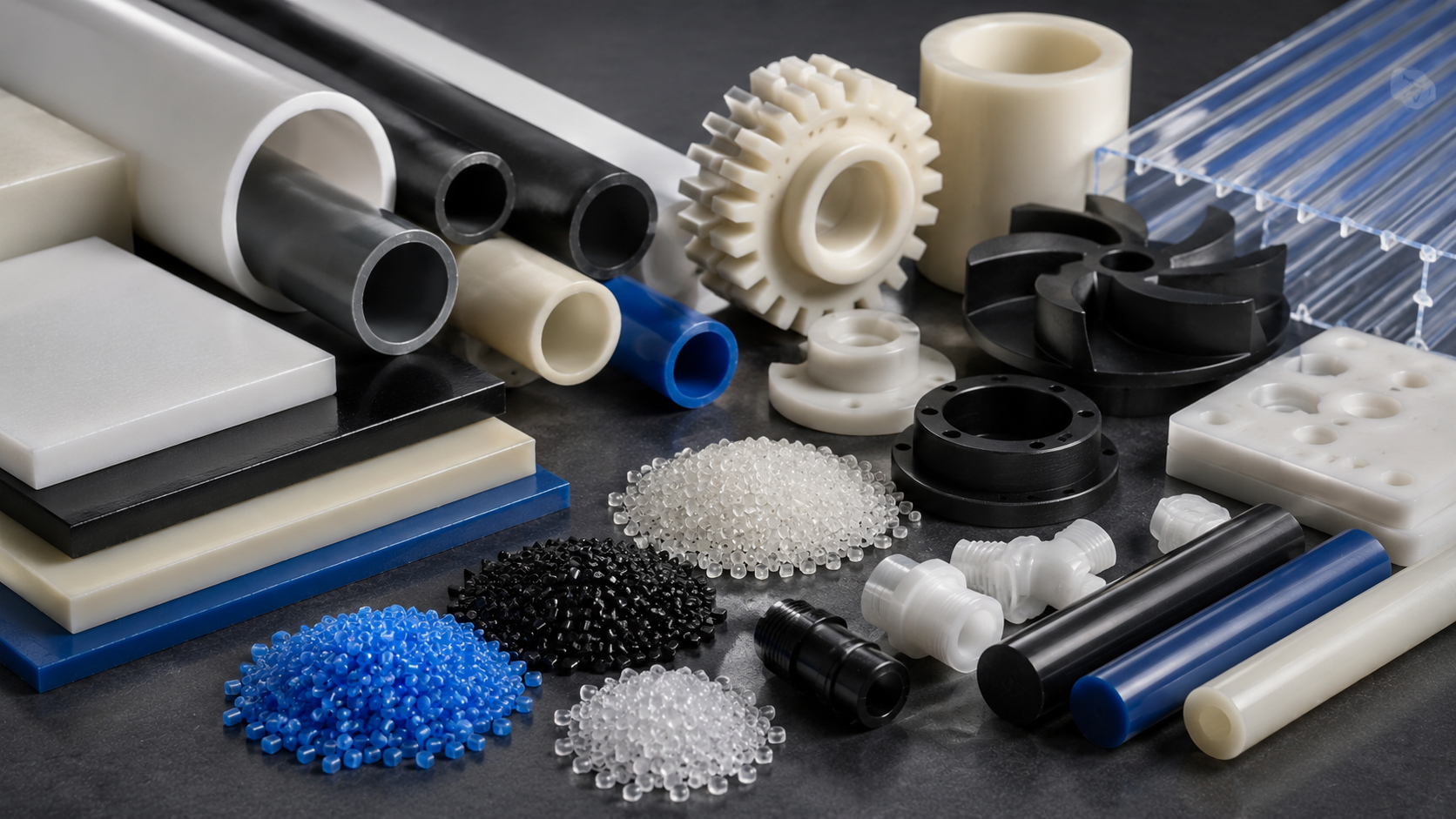
 Polymer is a substance composed of very large molecules, called macromolecules, that are made up of many smaller repeating units known as monomers. These monomers are chemically bonded together in long chains, branched structures, or interconnected networks. Polymers can occur naturally, such as cellulose in plants, proteins in living organisms, and natural rubber, or they can be manufactured synthetically, such as polyethylene, polypropylene, nylon, and polystyrene.
Common natural polymers include proteins (made from amino acid monomers), DNA and RNA (made from nucleotide monomers), cellulose, and natural rubber. Synthetic polymers include widely used materials such as polyethylene, polypropylene, polyvinyl chloride (PVC), polystyrene, and nylon. These substances are central to plastics, fibers, rubbers, adhesives, and coatings. Their properties, such as flexibility, strength, thermal behavior, and molecular weight—depend on the type of monomers, the length of the chains, and the degree of cross-linking or branching.
| Science |
| Applied Science |
| Engineering |
| Chemical Engineering |
| Material Science |
| Polymer |
In chemistry, polymers are classified in various ways, including as addition polymers (formed without loss of small molecules) or condensation polymers (formed with the elimination of small molecules like water), and as thermoplastics or thermosets based on their response to heat.
Polymer Classifications
Origin/Source - Natural polymers (e.g., proteins, cellulose, starch, natural rubber), synthetic polymers (e.g., polyethylene, PVC, nylon), and semi-synthetic polymers (e.g., cellulose acetate, vulcanized rubber).
Polymerization Mechanism - Addition polymers (or chain-growth polymers, formed by sequential addition of monomers without loss of small molecules, e.g., polyethylene, polystyrene) and condensation polymers (or step-growth polymers, formed with elimination of small molecules like water, e.g., nylon, polyester).
Thermal Behavior/Response to Heat - Thermoplastics (which soften on heating and harden on cooling, can be reshaped, e.g., polyethylene, PVC) and thermosetting polymers (or thermosets, which undergo irreversible cross-linking on heating and do not soften, e.g., bakelite, epoxy resins).
Molecular Structure/Architecture - Linear polymers (straight chains), branched polymers (with side chains), and cross-linked or network polymers (three-dimensional interconnected structures).
Monomer Composition - Homopolymers (made from a single type of monomer, e.g., polyethylene) and copolymers (made from two or more different monomers, which can be further classified as random, alternating, block, or graft copolymers).
Intermolecular Forces or Mechanical Properties - Elastomers (rubbery, elastic, e.g., natural rubber, Buna-S), fibers (high tensile strength, e.g., nylon, polyester), thermoplastics/plastics (rigid or semi-rigid, e.g., polystyrene), and resins (often used as adhesives or coatings).
Physical Properties
Physical properties of polymers are the characteristics that can be observed or measured without changing the chemical composition, and they vary significantly depending on the specific polymer type, molecular weight, structure, and conditions.
Density - Polymers generally have low densities compared to metals and ceramics, typically ranging from about 0.9 to 2.0 g/cm³, influencing their lightweight applications.
Mechanical Properties - Include tensile strength, elasticity, toughness, and viscoelasticity; these increase with higher molecular weight and chain entanglements, with polymers showing behaviors from rigid and brittle to flexible and rubbery.
Thermal Properties - Key transitions include the glass transition temperature (Tg), below which polymers are hard and glassy, and for semi-crystalline polymers, a melting temperature (Tm); they often exhibit high thermal stability but do not have sharp melting points like small molecules.
Crystallinity - Polymers can be amorphous (less rigid, more transparent), semi-crystalline, or crystalline, affecting rigidity, tensile strength, opacity, and solvent resistance.
Optical Properties - Range from transparent (amorphous) to opaque (due to light scattering in crystalline regions).
Electrical Properties - Many are good insulators with low conductivity, though this can be modified.
Solubility and viscosity - Depend on molecular weight; higher chain length increases solution and melt viscosity.