Tapered T-beam, also called tapered tee beam, is a type of structural beam with a T-shaped cross-sectional profile that changes dimensions along its length. This means that the stem of the T-beam gradually becomes narrower or wider as the beam extends from one end to the other. The tapering of the beam's dimensions can be subtle or more pronounced, depending on the specific engineering requirements of the structure.
area of a Tapered T Beam formula |
||
| \( A \;=\; w\cdot s + \dfrac{ h \cdot \left(T + t \right) }{2} \) | ||
| Symbol | English | Metric |
| \( A \) = area | \( in^2 \) | \( mm^2 \) |
| \( h \) = height | \( in \) | \( mm \) |
| \( t \) = thickness | \( in \) | \( mm \) |
| \( T \) = thickness | \( in \) | \( mm \) |
| \( s \) = width | \( in \) | \( mm \) |
| \( w \) = width | \( in \) | \( mm \) |
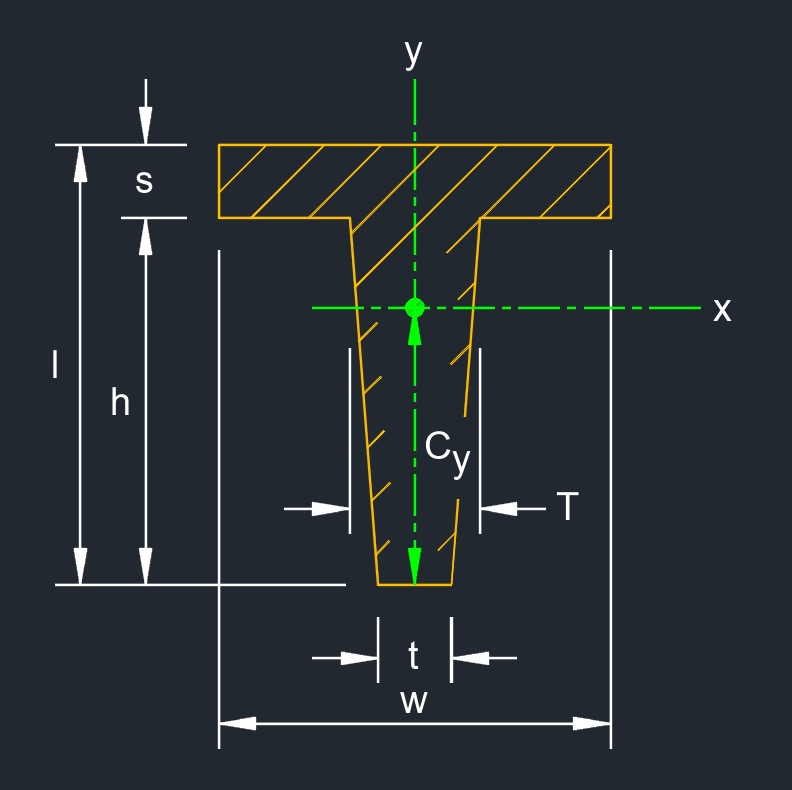 Tapered T-beams are often used in situations where the load distribution, spans, or other design considerations change along the length of the beam. This design allows for optimization of materials and structural performance while accommodating varying loads.
Distance from Centroid of a Tapered T Beam formulas |
||
|
\( C_x \;=\; 0 \) \( C_y \;=\; l - \dfrac{1}{6\cdot A} \cdot \left[ 3\cdot w\cdot s^2 + 3\cdot h\cdot t \cdot \left( l + s \right) + h \cdot \left( T - t \right) \cdot \left( h + 3\cdot s \right) \right] \) |
||
| Symbol | English | Metric |
| \( C \) = distance from centroid | \( in \) | \( mm \) |
| \( A \) = area | \( in^2 \) | \( mm^2 \) |
| \( h \) = height | \( in \) | \( mm \) |
| \( l \) = height | \( in \) | \( mm \) |
| \( t \) = thickness | \( in \) | \( mm \) |
| \( T \) = thickness | \( in \) | \( mm \) |
| \( s \) = width | \( in \) | \( mm \) |
| \( w \) = width | \( in \) | \( mm \) |
 See Article
Elastic section Modulus of a Tapered T Beam formual |
||
| \( S_{x} \;=\; \dfrac{ I_{x} }{ C_{y} } \) | ||
| Symbol | English | Metric |
| \( S \) = elastic section modulus | \( in^3 \) | \( mm^3 \) |
| \( C \) = distance from centroid | \( in \) | \( mm \) |
| \( I \) = moment of inertia | \( in^4 \) | \( mm^4 \) |
Perimeter of a Tapered T Beam formula |
||
| \( P \;=\; 2\cdot w + 2\cdot s - T + t + 2\cdot \sqrt{ \left( \dfrac{1}{2} \right)^2 + \left( \dfrac{T}{2} \right)^2 } \) | ||
| Symbol | English | Metric |
| \( P \) = perimeter | \( in \) | \( mm \) |
| \( t \) = thickness | \( in \) | \( mm \) |
| \( T \) = thickness | \( in \) | \( mm \) |
| \( s \) = width | \( in \) | \( mm \) |
| \( w \) = width | \( in \) | \( mm \) |
Radius of Gyration of a Tapered T Beam formulas |
||
|
\( k_{x} \;=\; \sqrt{ \dfrac{ I_x }{ A } } \) \( k_{x1} \;=\; \sqrt{ \dfrac{ I_{x1} }{ A } } \) |
||
| Symbol | English | Metric |
| \( k \) = radius of gyration | \( in \) | \( mm \) |
| \( A \) = area | \( in^2 \) | \( mm^2 \) |
| \( I \) = moment of inertia | \( in^4 \) | \( mm^4 \) |
Second Moment of Area of a Tapered T Beam formulas |
||
|
\( I_{x} \;=\; \dfrac{ \left[ 4\cdot w\cdot s^3 + h^3 \cdot \left( 3\cdot t + T \right) \right] - A \cdot \left( l - C_y - s \right)^2 }{12} \) \( I_{x1} \;=\; I_{x} + A \cdot C_{y} \) |
||
| Symbol | English | Metric |
| \( I \) = moment of inertia | \( in^4 \) | \( mm^4 \) |
| \( A \) = area | \( in^2 \) | \( mm^2 \) |
| \( C \) = distance from centroid | \( in \) | \( mm \) |
| \( h \) = height | \( in \) | \( mm \) |
| \( l \) = height | \( in \) | \( mm \) |
| \( t \) = thickness | \( in \) | \( mm \) |
| \( T \) = thickness | \( in \) | \( mm \) |
| \( s \) = width | \( in \) | \( mm \) |
| \( w \) = width | \( in \) | \( mm \) |