Center of gravity, abbreviated as \(CG\), is the theoretical point in a body through which the entire weight of the body can be considered to act. In other words, the center of gravity is the point at which the distributed gravitational force acting on all the mass of an object can be represented by a single resultant force. For a body in a uniform gravitational field, the center of gravity coincides with the center of mass.
Center of Gravity Formula |
||
|
\( CG \;=\; \dfrac{ I }{ V_o \cdot \left( B + M \right) } \) (Center of Gravity) \( I \;=\; \dfrac{ CG \cdot V_o }{ B + M } \) \( V_o \;=\; \dfrac{ I \cdot \left( B + M \right) }{ CG } \) \( B \;=\; \dfrac{ CG \cdot V_o }{ I } - M \) \( M \;=\; \dfrac{ CG \cdot V_o }{ I } - B \) |
||
| Symbol | English | Metric |
| \( CG \) = Center of Gravity | \(ft\) | \(m\) |
| \( I \) = Moment of Inertia | \(lbm \;/\; ft^2\) | \(kg \;/\; m^2\) |
| \( V_o \) = Volume of Object | \(ft^3\) | \(m^3\) |
| \( B \) = Center of Bouyancy | \(ft\) | \(m\) |
| \( M \) = Metacenter | \(dimensionless\) | \(dimensionless\) |
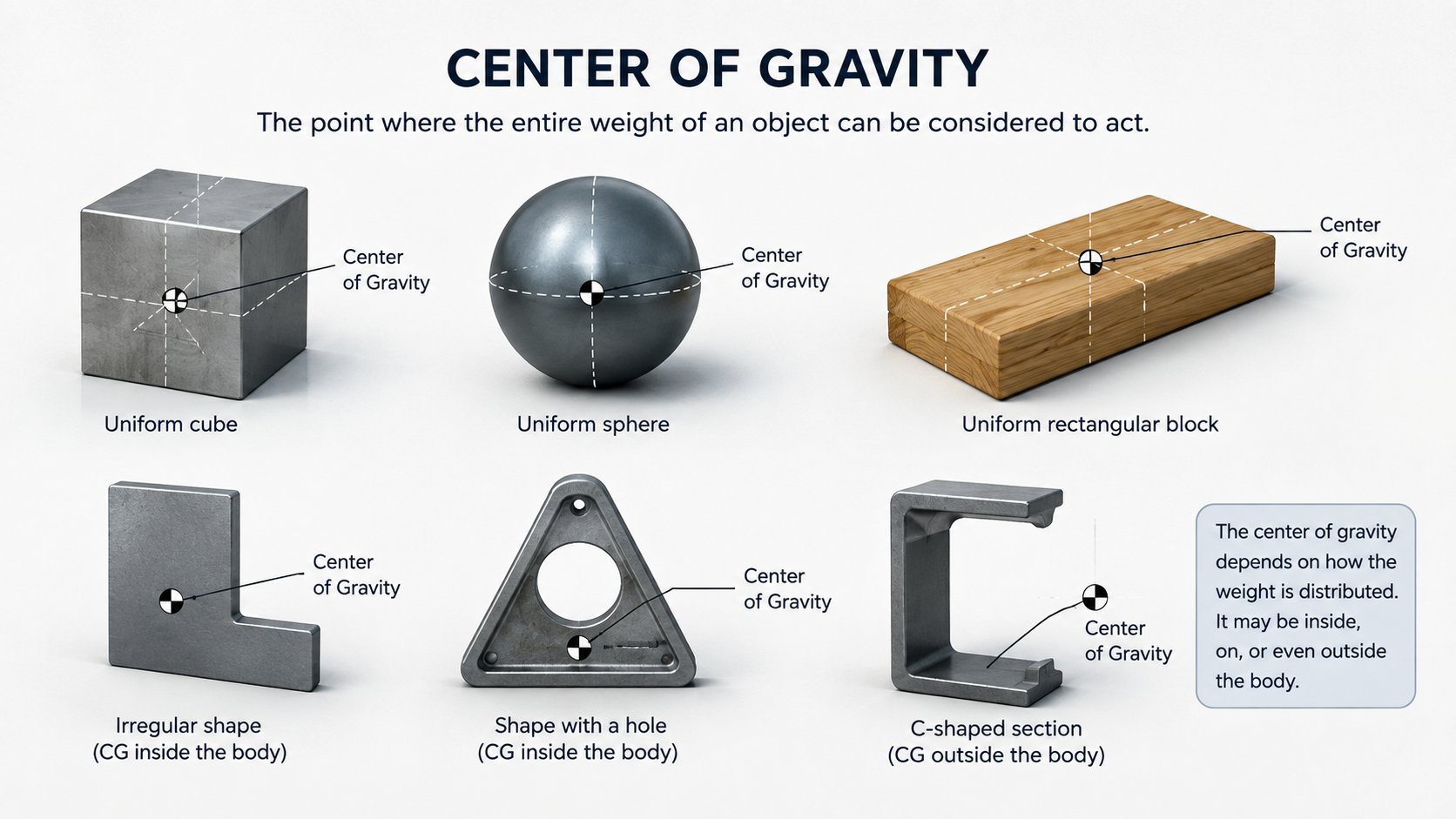
The location of the center of gravity depends on how the weight is distributed throughout the body. For a symmetrical, uniform object, the center of gravity is typically located at its geometric center. For an irregular object or an object made from materials of different densities, the center of gravity may be located away from the geometric center and can even lie outside the physical boundaries of the object.
In engineering, the center of gravity is important when analyzing equilibrium, stability, lifting, structural loads, vehicle dynamics, and moments. If the line of action of the body's weight passes through an appropriate support region, the body can remain stable. If the line of action moves outside the supporting region, the body may tip or overturn.