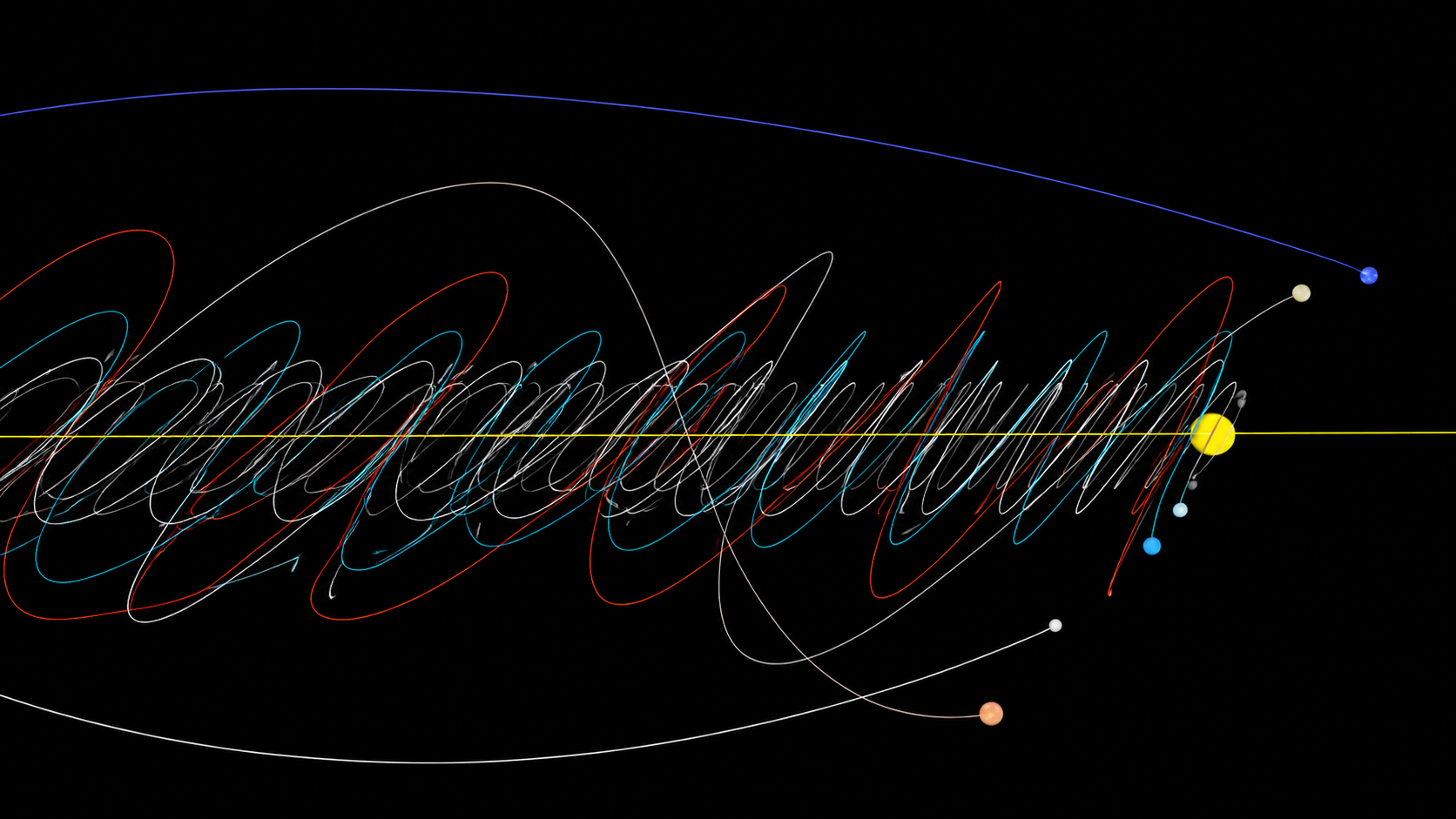
 Solar System is the gravitationally bound system consisting of the Sun and all natural and artificial objects that orbit it. The Sun is a star located at the center of the Solar System and contains more than 99% of the system’s total mass. Its immense gravitational force holds the planets, dwarf planets, moons, asteroids, comets, meteoroids, dust, and gas in orbit around it. The Solar System formed approximately 4.6 billion years ago from the gravitational collapse of a large cloud of gas and dust known as a solar nebula. As this cloud contracted, most of the material accumulated at the center to form the Sun, while the remaining material flattened into a rotating disk from which the planets and other bodies developed. The Solar System has a rotational motion around the Suns axis, the planets orbit the Sun, and the entire Solar System orbits the center of the Milky Way.
The eight recognized planets of the Solar System, listed in order of increasing distance from the Sun, are Mercury, Venus, Earth, Mars, Jupiter, Saturn, Uranus, and Neptune. The four inner planets, Mercury, Venus, Earth, and Mars are primarily composed of rock and metal and are known as terrestrial planets. The four outer planets, Jupiter, Saturn, Uranus, and Neptune are much larger and consist mainly of gases, ices, and fluids. Jupiter and Saturn are commonly classified as gas giants, while Uranus and Neptune are classified as ice giants.
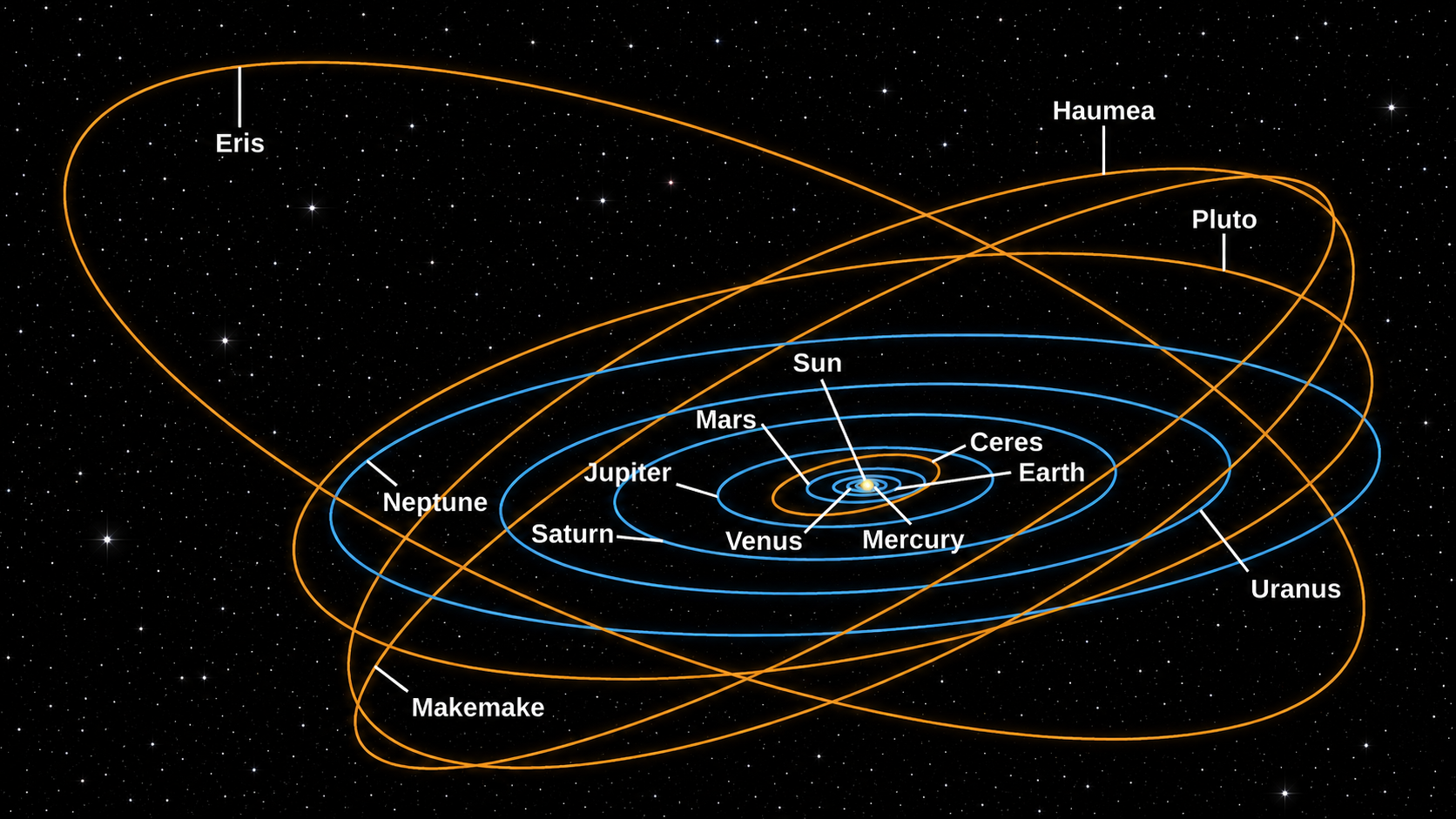 In addition to the planets, the Solar System contains dwarf planets, including Pluto, Ceres, Eris, Haumea, and Makemake. Many planets and dwarf planets possess natural satellites, commonly called moons. The Solar System also contains millions of smaller objects. Most asteroids are concentrated in the Asteroid Belt located between Mars and Jupiter, while many comets originate from distant reservoirs known as the Kuiper Belt and the Oort Cloud. The Kuiper Belt is a region beyond Neptune containing numerous icy bodies, whereas the Oort Cloud is a vast, distant spherical region believed to surround the Solar System and serve as a source of many long-period comets.
The distances within the Solar System are immense. Astronomers commonly use the astronomical unit (AU), which is defined as the average distance between Earth and the Sun, approximately 149.6 million kilometers (93 million miles). Neptune, the outermost planet, orbits at an average distance of about 30 AU from the Sun, while the Oort Cloud may extend thousands to tens of thousands of AU farther outward.
The Solar System can be defined as the Sun and every object that is gravitationally bound to it, including planets, dwarf planets, moons, asteroids, comets, meteoroids, dust, gas, and other small bodies, all moving through space under the influence of the Sun’s gravity.
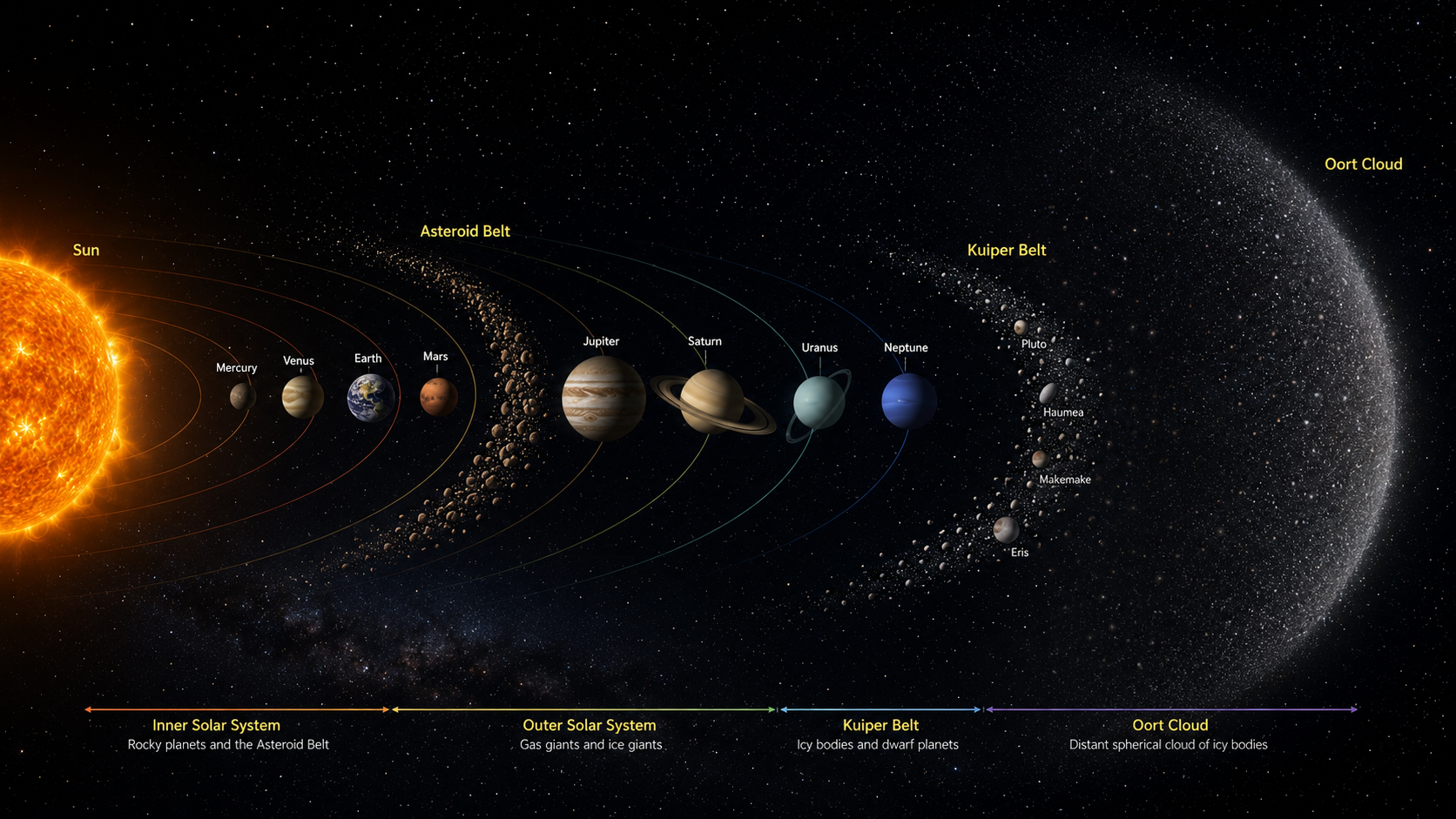 Solar System Planets
Solar System Assumptions
Namesake - The Solar System is named after the Sun. The word "solar" comes from the Latin word Sol, meaning "Sun."
What the Solar System Is - The Solar System is the gravitationally bound system consisting of the Sun and all natural and artificial objects that orbit it.
Location in the Milky Way - The Solar System exists within the galaxy known as the Milky Way. It is located in the Orion Arm (also called the Orion Spur), a minor spiral arm situated between the Sagittarius Arm and the Perseus Arm.
Distance from the Galactic Center - The Solar System is approximately 26,000–27,000 light-years from the center of the Milky Way.
Milky Way Size - The Milky Way is approximately 100,000–120,000 light-years in diameter. Estimates vary, but this range is widely accepted.
Central Object of the Solar System - The Sun contains approximately 99.8% of the total mass of the Solar System.
Sun Classification - The Sun is a G-type main-sequence star (G2V), commonly called a yellow dwarf star.
Number of Stars - The Solar System contains one known star: the Sun.
Number of Planets - The Solar System contains eight recognized planets:
Dwarf Planets: Recognized dwarf planets include:
- Ceres
- Pluto
- Haumea
- Makemake
- Eris
Planetary Orbits - All eight planets orbit the Sun in elliptical paths, with the Sun located near one focus of each ellipse.
Direction of Orbit - Viewed from above the Sun's north pole, all eight planets orbit counterclockwise.
Solar System Rotation - The Solar System does not rotate as a rigid body. Individual objects orbit the Sun, while the Sun itself rotates on its axis approximately once every 25 days at the equator and more slowly near its poles.
Solar System Motion Through the Milky Way - The Solar System orbits the center of the Milky Way.
Galactic Orbital Speed - The Solar System travels around the Milky Way at approximately 220 kilometers per second (about 137 miles per second).
Galactic Orbital Period - One complete orbit around the Milky Way, often called a "galactic year," takes approximately 225–250 million Earth years.
Age of the Solar System - Approximately 4.57 billion years.
Formation - The Solar System formed from the gravitational collapse of a region within a large molecular cloud.
Major Regions -
- Inner Solar System (Mercury through Mars)
- Asteroid Belt
- Outer Solar System (Jupiter through Neptune)
- Kuiper Belt
- Scattered Disc
- Oort Cloud (hypothesized outer reservoir of icy bodies)
Asteroid Belt Location - Between the orbits of Mars and Jupiter.
Kuiper Belt Location - Beyond Neptune, extending roughly from 30 AU to 50 AU from the Sun.
Oort Cloud - A hypothesized spherical cloud of icy bodies surrounding the Solar System at great distances. Its existence is supported indirectly by observations of long-period comets.
Natural Satellites (Moons) - More than 290 confirmed moons are known to orbit planets and dwarf planets in the Solar System. The exact number changes as new discoveries are confirmed.
Small Solar System Bodies - Asteroids, Comets, Meteoroids, Trans-Neptunian Objects, and Centaurs
Heliosphere - The Solar System is surrounded by the heliosphere, a vast bubble created by the solar wind emitted by the Sun.
Heliopause - The outer boundary where the solar wind is balanced by the interstellar medium.
Interstellar Medium - Beyond the heliopause lies the interstellar material that exists between stars in the Milky Way.
Largest Planet - Jupiter.
Smallest Planet - Mercury.
Hottest Planet - Venus.
Only Known Planet with Life - Earth.
Total Size of the Planetary System - Neptune's average orbital distance is about 30 AU from the Sun. The Solar System's gravitational influence extends far beyond this, potentially out to the distant Oort Cloud, which may extend tens of thousands to over 100,000 AU from the Sun.
Shape of the Planetary System - The major planets orbit within a relatively thin, flattened disk called the ecliptic plane.
Dominant Force - Gravity is the primary force governing the motions of Solar System bodies.
Nearest Star Beyond the Sun - Proxima Centauri, approximately 4.24 light-years from Earth.
Nearest Galaxy Beyond the Milky Way Visible to the Naked Eye - Andromeda Galaxy, approximately 2.5 million light-years away.
Current Scientific Status - The Solar System remains the only known planetary system confirmed to contain life.