
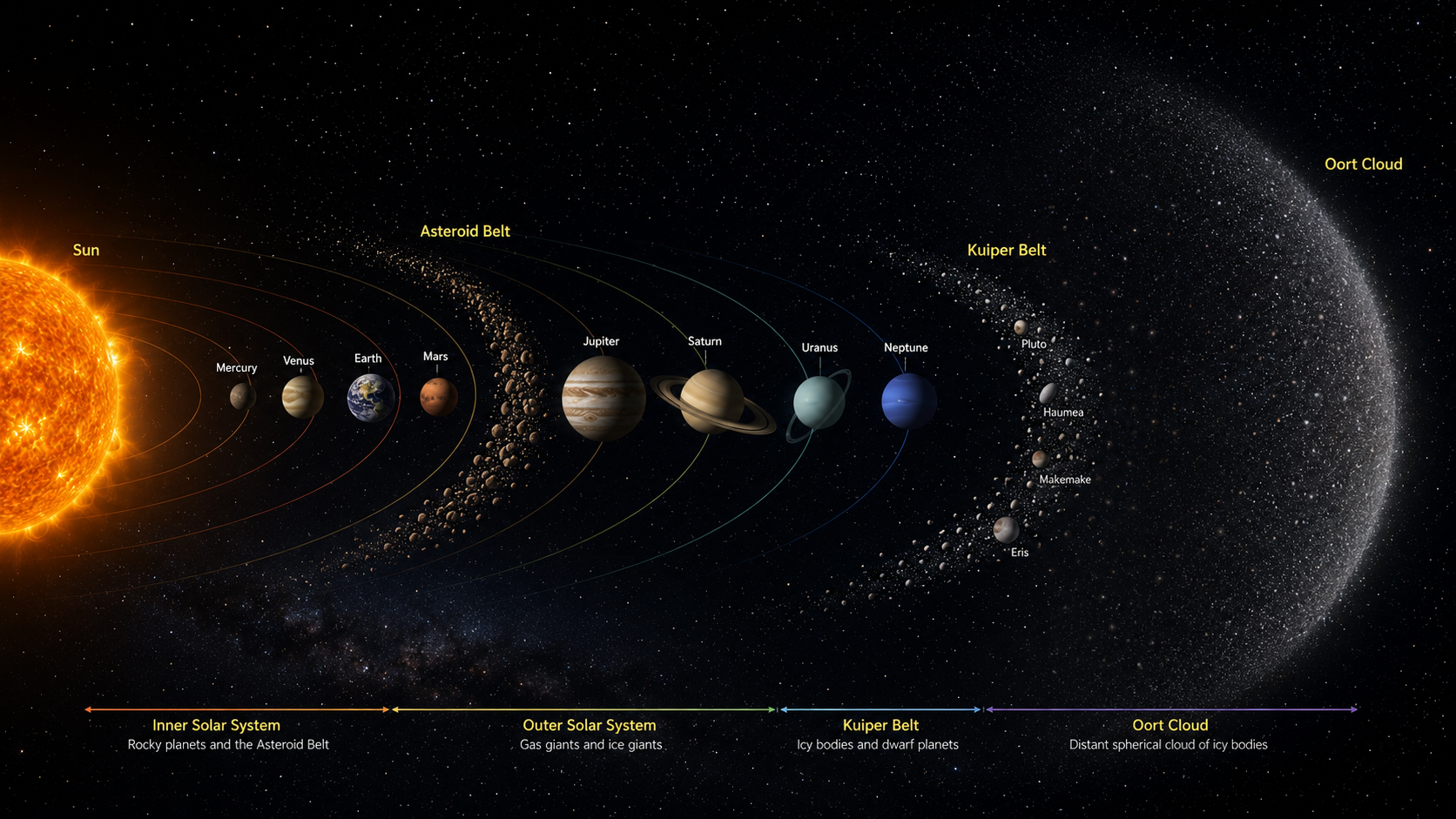
Jupiter is the fifth planet from the Sun and the largest planet in the Solar System. It is classified as a gas giant, although modern planetary science recognizes that much of its interior is composed of fluids under extreme pressure rather than gases in the ordinary sense. Jupiter contains more mass than all the other planets in the Solar System combined. Its immense gravitational influence has played a major role in shaping the structure and evolution of the Solar System.
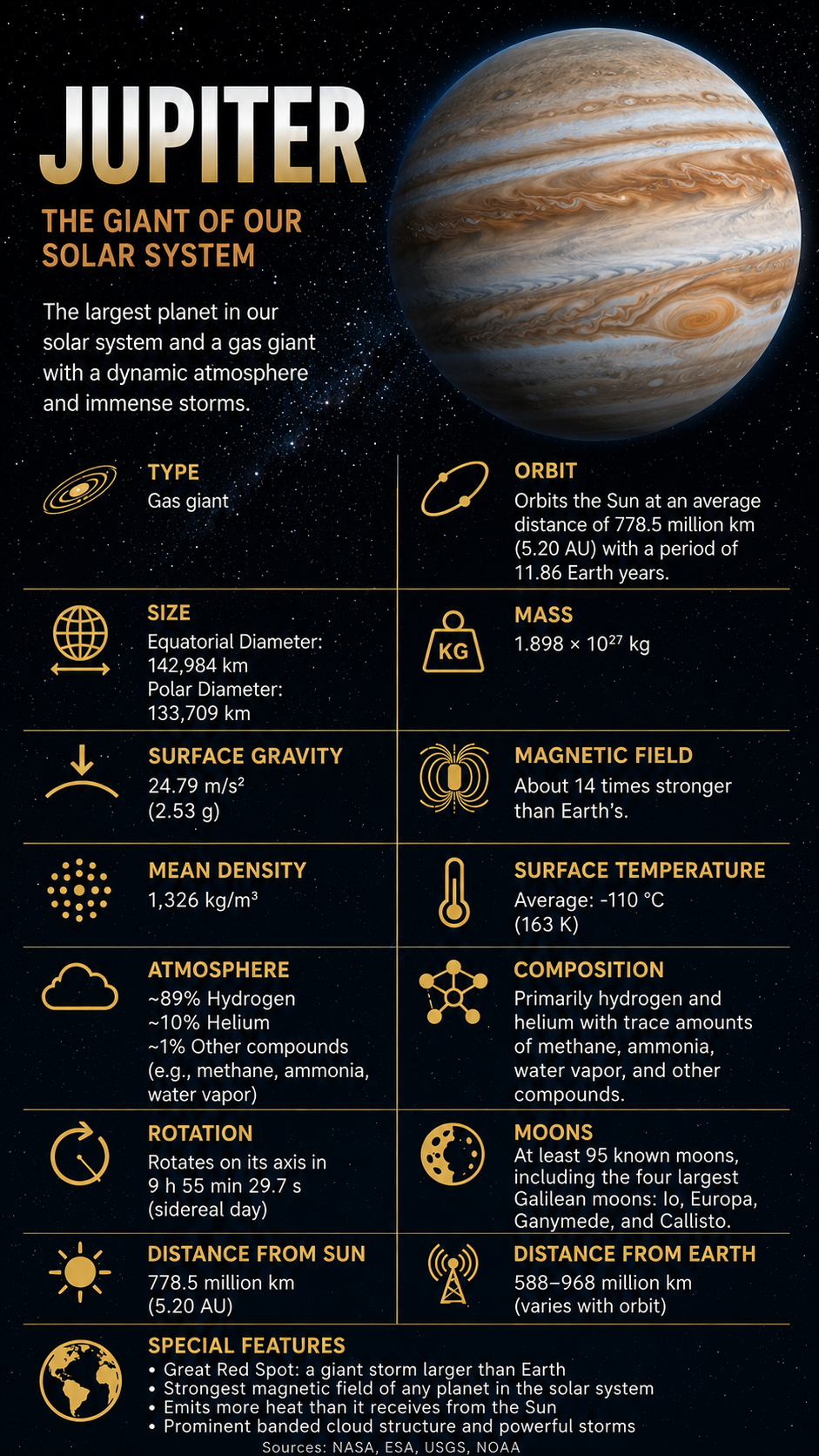
 Jupiter is composed primarily of hydrogen and helium, the same elements that dominate the Sun. Measurements from spacecraft observations indicate that hydrogen makes up the majority of the planet's mass, with helium being the second most abundant component. Trace amounts of methane, ammonia, water vapor, hydrogen sulfide, and other compounds are also present in the atmosphere. Beneath the visible clouds, pressure and temperature increase dramatically with depth. Scientists conclude from observations, measurements, and physical models that hydrogen transitions into a metallic liquid state deep within Jupiter's interior. This layer of metallic hydrogen is believed to be responsible for generating Jupiter's powerful magnetic field.
The planet's atmosphere is characterized by alternating dark belts and light zones that encircle the globe. These bands are produced by complex atmospheric circulation patterns driven by Jupiter's rapid rotation and internal heat. The atmosphere contains powerful storms, jet streams, vortices, and turbulent cloud systems. The most famous atmospheric feature is the Great Red Spot, a gigantic storm that has been observed continuously since at least the seventeenth century. The storm is large enough to contain Earth and is one of the longest lived known atmospheric phenomena in the Solar System.
Jupiter has an extremely strong magnetic field, the most powerful planetary magnetic field in the Solar System. This magnetic field creates a vast magnetosphere that extends millions of kilometers into space. Charged particles trapped within the magnetosphere produce intense radiation belts that can pose serious hazards to spacecraft.
The planet possesses a faint ring system composed mainly of dust particles, although much less prominent than the rings of Saturn. The rings are believed to be continually replenished by dust generated from impacts on some of Jupiter's small moons. Jupiter has a large and diverse system of natural satellites. More than ninety moons have been confirmed. The four largest moons, Io, Europa, Ganymede, and Callisto, are collectively known as the Galilean moons. Io is the most volcanically active known body in the Solar System. Europa possesses a global subsurface ocean beneath an icy crust. Ganymede is the largest moon in the Solar System and is larger than the planet Mercury. Callisto is heavily cratered and preserves a record of ancient impacts.