
Solar day is the time interval between two successive passages of the Sun across the same celestial meridian, or, the time it takes for the Sun to return to the same apparent position in the sky as observed from a fixed point on Earth, such as from local noon to local noon. This is the basis for the familiar 24-hour civil day used in everyday timekeeping. Because Earth both rotates on its axis and orbits the Sun, a solar day is slightly longer than the time for one full 360-degree rotation relative to distant stars. The orbital motion means Earth must rotate approximately an extra degree each day to bring the Sun back to the same position, resulting in an average solar day of 24 hours.
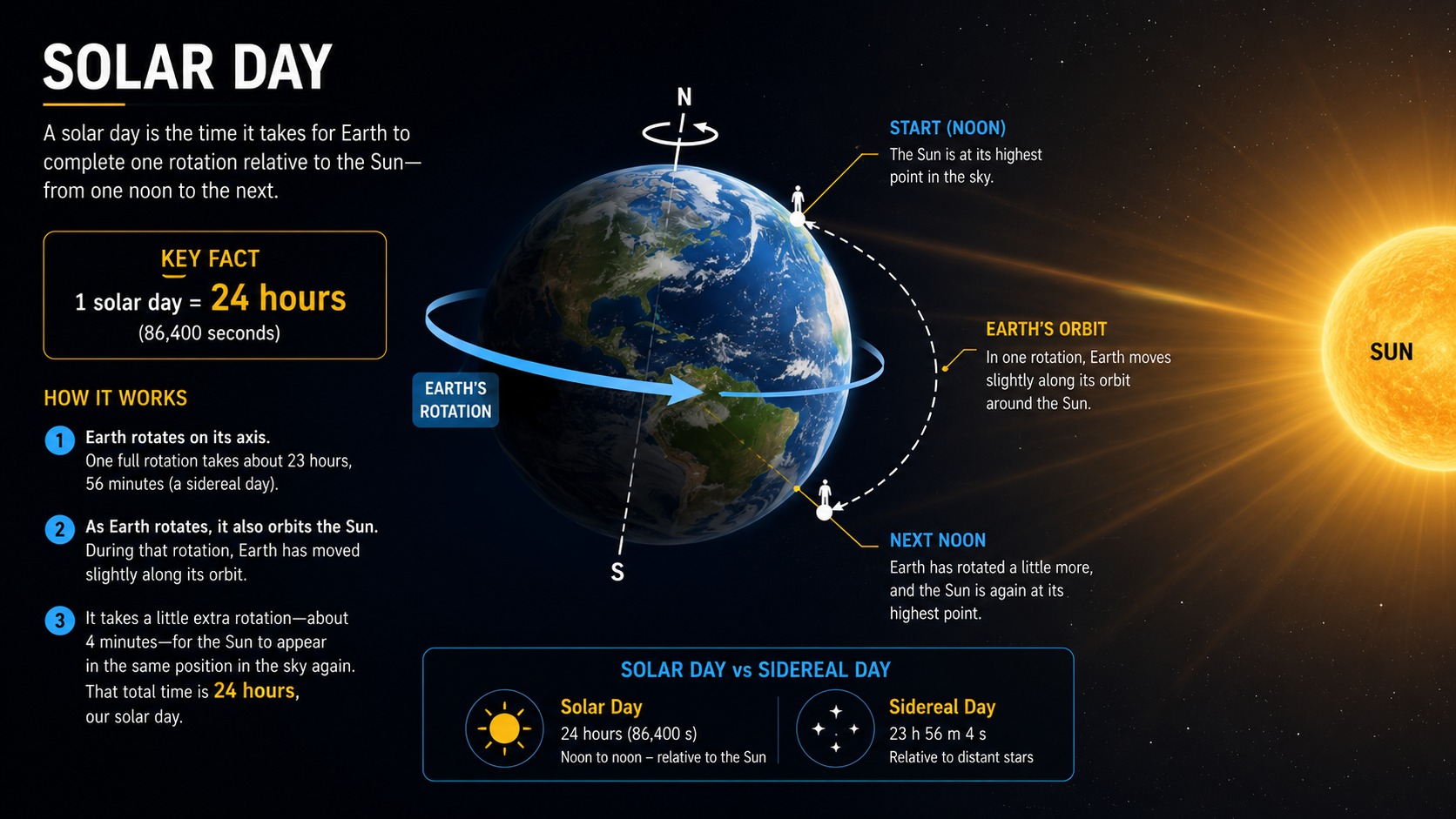 The apparent solar day, based on the real Sun's position, varies slightly throughout the year due to Earth's elliptical orbit and the tilt of its axis, which cause the Sun's apparent speed along the ecliptic to change. To create a uniform time standard, the mean solar day is defined using a fictitious mean Sun that moves at a constant average speed along the celestial equator. This mean solar day is exactly 24 hours on average and serves as the foundation for civil time.
In contrast to a sidereal day, which measures one rotation relative to the fixed stars and lasts about 23 hours, 56 minutes, and 4 seconds, the solar day accounts for the combined effects of rotation and revolution. Over the course of a year, this difference accumulates such that there is one more sidereal day than solar days in Earth's orbit around the Sun. The mean solar day is defined as exactly 24 hours on average. The apparent solar day varies slightly throughout the year (by up to ~±30 seconds) due to Earth's elliptical orbit and axial tilt (equation of time).