
Earth’s moon is the only natural satellite of Earth. It is a rocky, terrestrial body that orbits Earth at an average distance of approximately 384,400 kilometers (238,855 miles). With a mean radius of about 1,737 kilometers (1,080 miles), The Moon is roughly one quarter the diameter of Earth and has a mass of about 1.2% of Earth’s, making it the largest moon in the Solar System relative to the size of its parent planet.
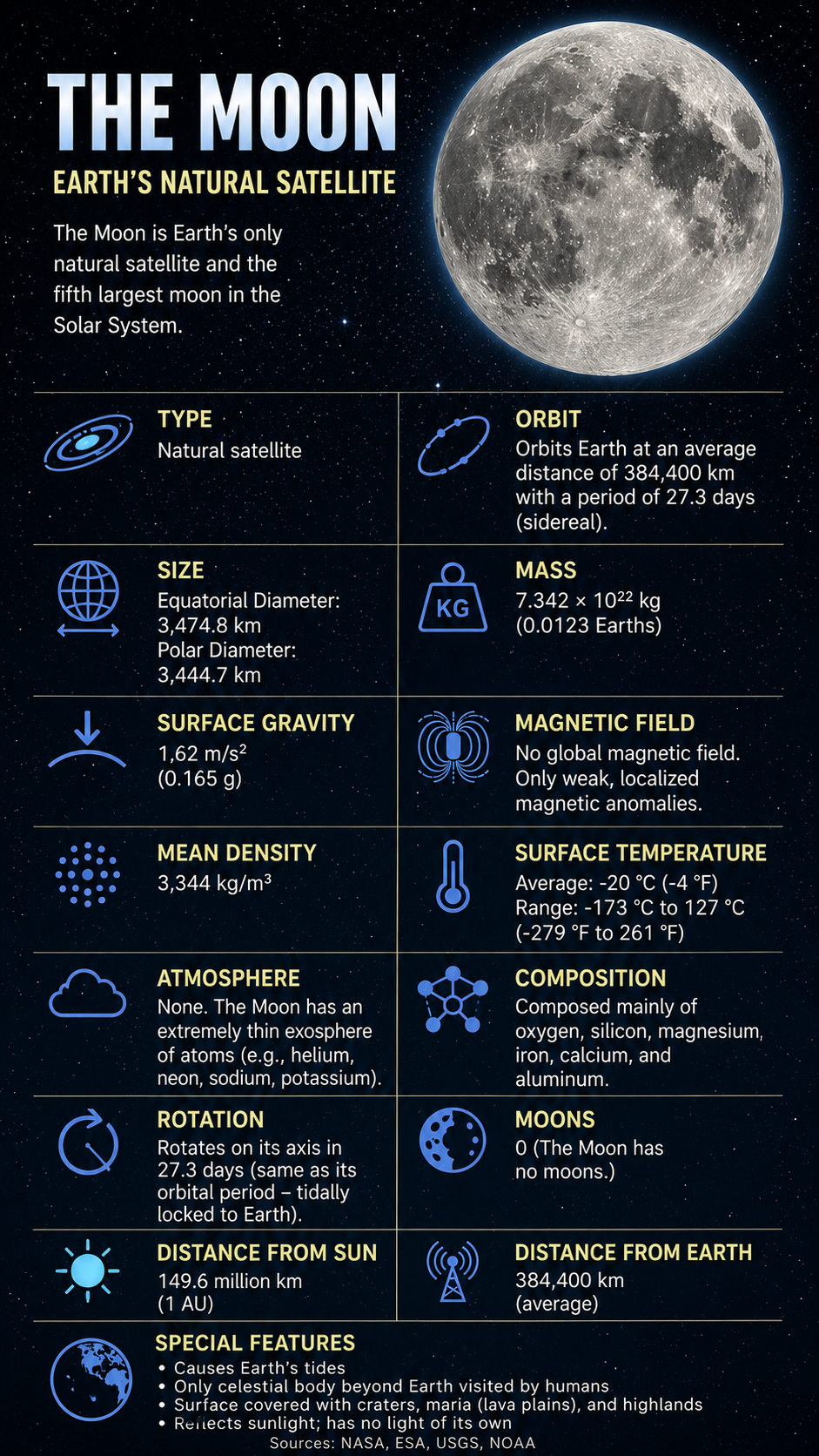
 The Moon is tidally locked to Earth, meaning it rotates on its axis at the same rate that it revolves around Earth, so the same hemisphere (the near side) always faces Earth. It completes one orbit around Earth in approximately 27.3 Earth days, which is also the length of its sidereal rotation period. The Moon’s surface gravity is about one-sixth that of Earth’s. It has no substantial atmosphere, no rings, and no moons of its own. Its surface is covered with a layer of fine, powdery regolith produced by billions of years of impact events. It features numerous impact craters, mountains, and large, dark basaltic plains known as maria, which formed from ancient volcanic activity that ceased around 1.2 billion years ago.
Like Earth, the Moon has a differentiated internal structure consisting of a crust, mantle, and core. It was once a molten world that cooled over time, with denser materials sinking to form the core. Surface temperatures vary dramatically due to the lack of atmosphere, ranging from about -173 C (-280 F) at night to 127 C (260 F) during the day in equatorial regions. The Moon influences Earth through gravitational interactions, most notably by causing ocean tides.