Retrograde motion is the apparent or actual movement of an astronomical object in a direction opposite to the normal direction of motion within a given reference frame. In astronomy, the term is most commonly used in two ways, apparent retrograde motion and true retrograde motion.
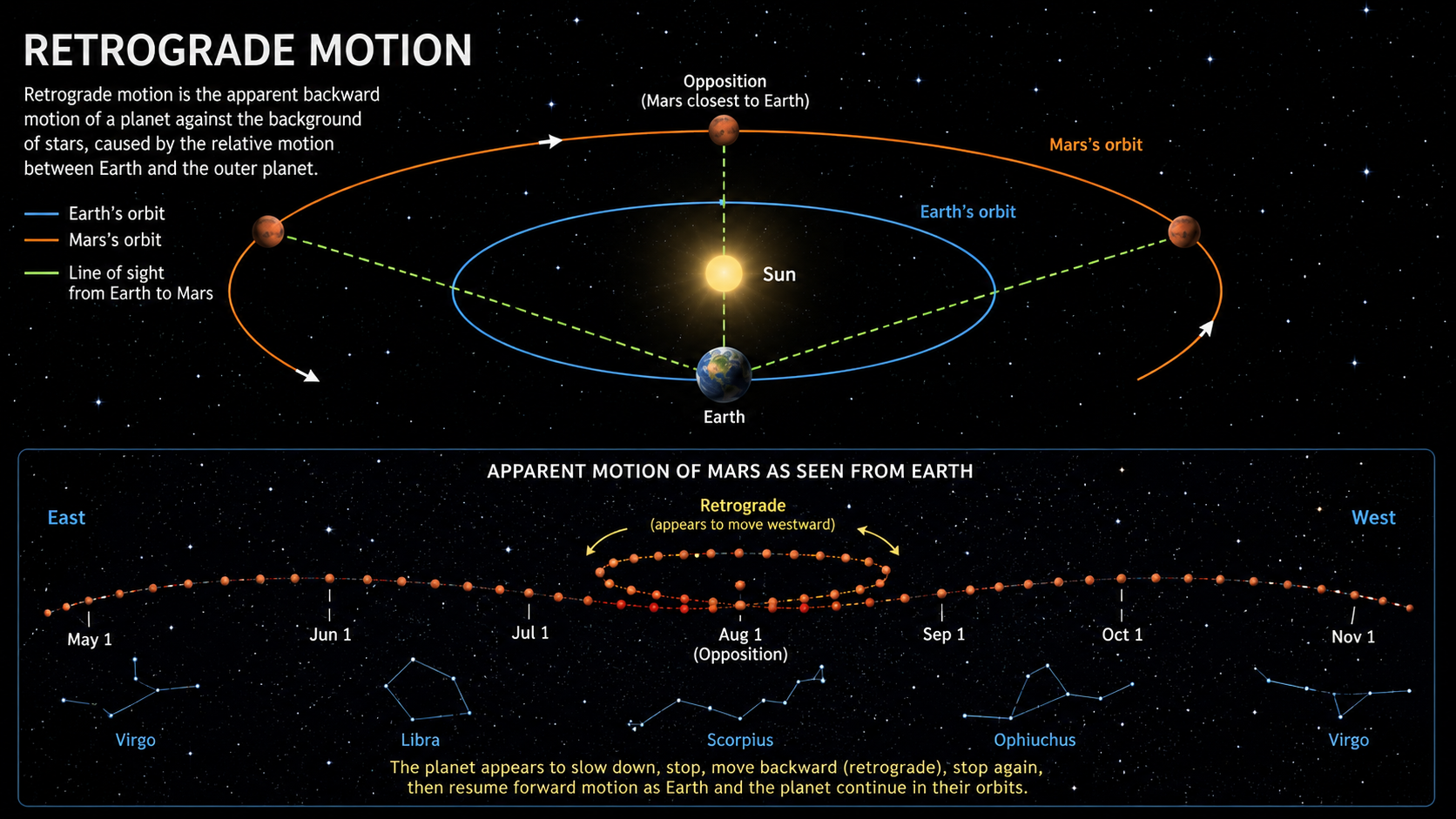 Apparent retrograde motion is the temporary reversal in the observed movement of a planet against the background stars as seen from Earth. Normally, planets appear to drift slowly eastward relative to the stars, a motion called prograde motion. However, at certain times a planet appears to slow down, stop, move westward for a period, and then resume its usual eastward motion. This effect is an optical and geometric phenomenon caused by the changing positions and orbital speeds of Earth and the other planet as both travel around the Sun. The planet does not actually reverse its orbital direction. For the outer planets, such as Mars, Jupiter, and Saturn, retrograde motion occurs when Earth, moving in a smaller and faster orbit, passes between the Sun and the outer planet. For the inner planets, Mercury and Venus, retrograde motion occurs when these planets pass between Earth and the Sun.
True retrograde motion describes an object that genuinely moves in the opposite direction compared with the predominant direction of rotation or revolution in a system. Most planets in the Solar System orbit the Sun in a counterclockwise direction when viewed from above the Sun's north pole, and this is called prograde motion. An object orbiting in the clockwise direction in that same reference frame is said to have a retrograde orbit. Several natural satellites exhibit retrograde orbits, particularly many irregular moons of the giant planets. Some comets and asteroids also follow retrograde paths around the Sun.