Conductance, abbreviated as \(G\), is the ability of a material to allow the flow of electric current. It is the reciprocal of electrical resistance. The higher the conductance, the better the material conducts electricity.
Conductance formula |
||
|
\( G \;=\; \dfrac{ P }{ V^2 }\) (Conductance) \( P \;=\; G \cdot V^2 \) \( V \;=\; \sqrt{ \dfrac{ P }{ G } } \) |
||
| Symbol | English | Metric |
| \( G \) = Conductance | \( S \) | \(S\) |
| \( P \) = Power | \( W \) | \( W \) |
| \( V \) = Voltage | \(V\) | \( V \) |
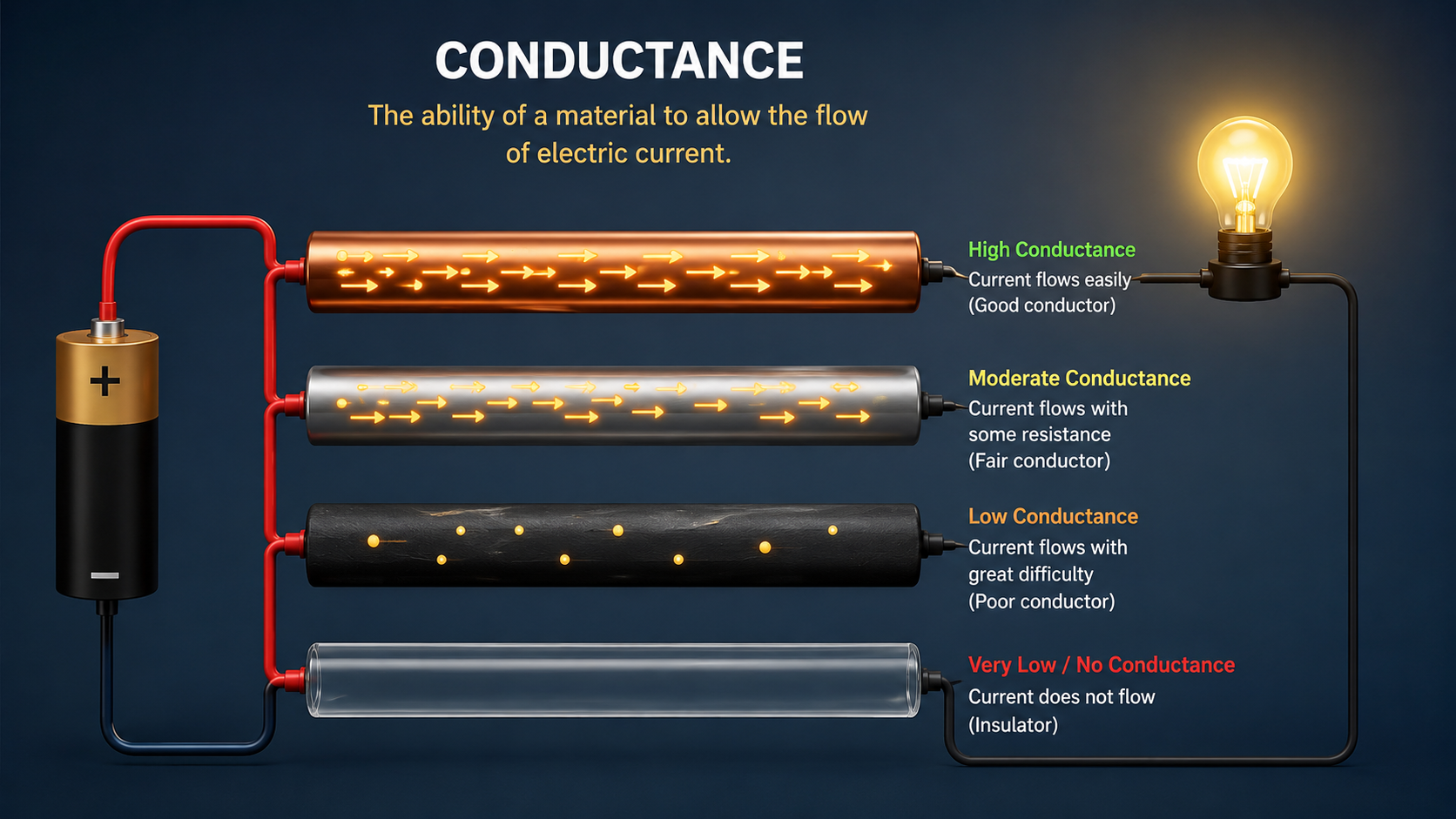
In the context of electricity, materials are often classified as conductors, insulators, or semiconductors based on their conductance properties. Metals, for example, are good conductors, while rubber is a good insulator. Semiconductors have properties that fall between conductors and insulators and are fundamental to the operation of electronic devices like transistors.
It's worth noting that conductance is a measure of the ease with which electric current flows through a material, whereas conductivity is a material property that describes how well a material conducts electricity. Conductivity is the product of the material's conductance and the cross-sectional area through which the current flows, divided by the distance along which the current travels.