Free water knockout, abbreviated as \(FWKO\), is a primary-phase separation process used in oil and gas production facilities to remove free (non-emulsified) water from a multiphase hydrocarbon stream. In upstream operations, produced fluids from a well commonly consist of crude oil, produced water, and associated gas. A free water knockout vessel is designed to separate and remove the bulk free water based on density differences and gravity settling before the stream proceeds to further treatment equipment such as heater treaters, electrostatic treaters, or separators. The objective is to reduce the water load on downstream equipment, improve separation efficiency, and minimize corrosion and handling costs associated with produced water.
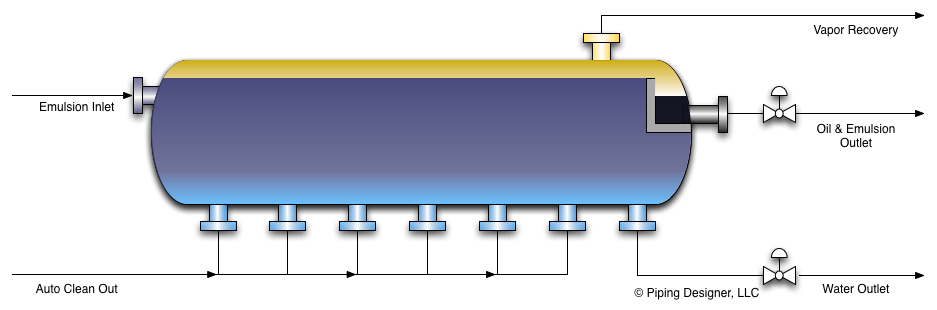
A free water knockout is typically a horizontal pressure vessel operating under controlled temperature and pressure conditions. The separation mechanism relies primarily on gravity segregation. Because produced water has a higher density than crude oil, free water settles to the bottom of the vessel, oil forms an intermediate layer, and gas disengages and accumulates in the vapor space at the top. Internals may include inlet diverters to reduce momentum and promote phase separation, weirs to control liquid levels, and mist extractors to minimize liquid carryover in the gas outlet. Retention time is a critical design parameter; sufficient residence time must be provided to allow free water droplets of a specified minimum size to settle in accordance with established gravity separation principles.
It is important to distinguish free water from emulsified water. A free water knockout removes only the water that is not chemically or mechanically emulsified in the oil phase. Emulsified water typically requires additional treatment, such as heat, chemical demulsifiers, or electrostatic coalescence, to achieve separation. Therefore, the FWKO functions as a bulk separation device rather than a final dehydration unit.
In standard oilfield processing terminology, “Free Water Knockout” refers both to the separation process and to the vessel used to accomplish it. The term is widely used in upstream petroleum engineering and production facility design, and its function and operating principles are consistent with established gravity-based phase separation theory.
Factors to Consider when Determining Free Water Knockout
Inlet Flow Rate (Total Liquid and Gas Rates) - The design and sizing of a Free Water Knockout (FWKO) vessel are directly dependent on the expected
volumetric flow rates of oil, water, and gas. Maximum, normal, and turndown conditions must be defined to ensure adequate residence time and vapor–liquid disengagement under all operating scenarios.
Phase Fractions (Water Cut and Gas–Liquid Ratio) - The percentage of produced water (water cut) and the gas–liquid ratio significantly influence vessel sizing, internal configuration, and liquid level control strategy. Higher water cut increases required liquid handling capacity and affects interface control requirements.
Fluid Physical Propeties - Density of oil and water (for gravity separation effectiveness). Viscosity of the oil phase (affects settling velocity of water droplets).
Surface tension between oil and water (influences droplet coalescence). These properties are required to evaluate separation performance using established gravity-settling relationships.
Droplet Size Distribution of Free Water - Separation performance depends on the minimum droplet size that must be removed. Settling velocity is governed by gravity separation principles (commonly evaluated using
Stokes’ law for laminar conditions), making droplet size a key design parameter.
Operating Pressure - The vessel must be designed for the maximum operating and design pressure. Operating pressure also affects gas density and volumetric flow, influencing vapor disengagement and overall vessel sizing.
Operating Temperature -
Temperature affects fluid
viscosity, density difference between oil and water, and separation efficiency. Higher temperatures generally reduce oil viscosity and enhance gravity separation.
Required Retention (Residence) Time - Adequate retention time must be provided to allow free water droplets to settle to the oil–water interface. Retention time is a primary sizing criterion for horizontal FWKO vessels.
Vapor–Liquid Disengagement Requirements - Gas capacity must be evaluated to prevent liquid carryover. Vapor space sizing is typically determined using established gas–liquid separator design criteria based on allowable superficial gas velocity.
Oil–Water Interface Control Requirements - Proper instrumentation and control strategy are necessary to maintain stable oil and water levels. Interface control design affects internal weir height, boot sizing (if applicable), and outlet configuration.
Emulsion Characteristics - Only free (non-emulsified) water is removed in an FWKO. The presence and stability of emulsions affect achievable separation efficiency and determine whether downstream treatment is required.
Solids Content (Sand or Formation Solids) - The presence of solids influences vessel configuration, potential need for sand jets or drains, and maintenance considerations.
Corrosion Considerations - Produced water composition (e.g., salinity, CO₂, H₂S content) affects material selection,
corrosion allowance, and internal coatings.
Applicable Design Codes and Standards - Pressure vessel design must comply with established codes (e.g., ASME pressure vessel standards where applicable), and separator design practices must follow recognized oil and gas industry standards.
Downstream Processing Requirements - The allowable residual water content in the oil leaving the FWKO must be defined to ensure compatibility with downstream equipment (e.g.,
heater treaters, electrostatic treaters, or stock tanks).
Free Water Knockout Typical Internals
Inlet Deflector or Baffle - Reduces disturbance from the inlet
fluids and keeps them from creating a channel through the FWKO.
Calming Baffle/ Wave Beaker - If you’re using that experiences surges, a baffle will help dampen inlet surges.
Weir Box - A weir box may be used to separate ensure that the oil/ emulsion outlet does not get contaminated with water.
Vortex Breaker - Discharge nozzle to prevent the discharge from drawing from the gas blanket.
Jets - Jets to direct flow rate to help clean out sand.
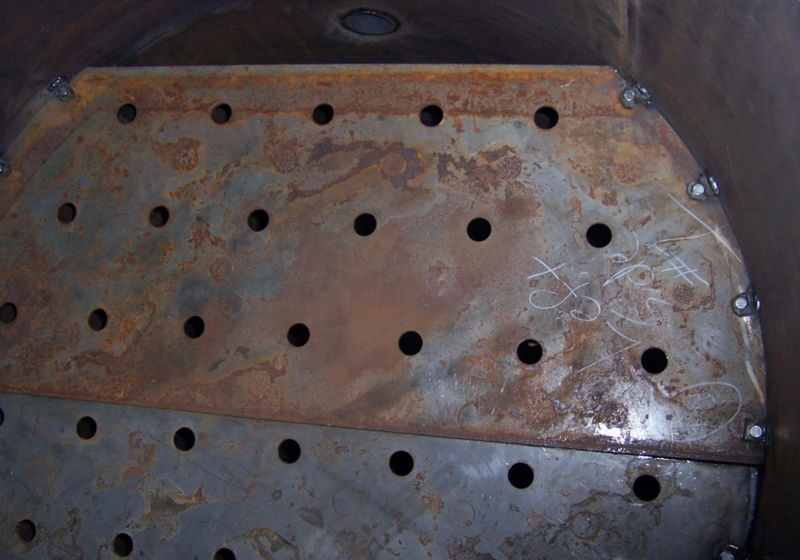 Wave breaker or calming baffle
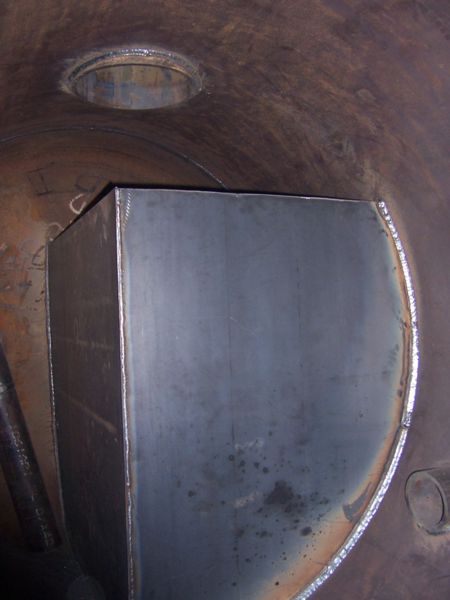 Oil wier in a vessel
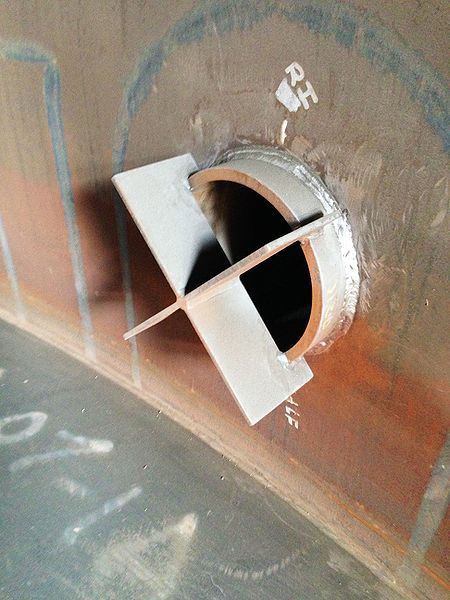 Vortex breaker in a tank