Corrosion allowance, abbreviated as \(CA\), is the amount of material in a pipe or vessel that is available for corrosion without affecting the pressure containing integrity. The amount of extra material added to a structure or component in order to compensate for the loss of material due to corrosion over time. Corrosion is a natural process that occurs when metal structures or components are exposed to a corrosive environment, such as seawater or acidic gases.
Corrosion Allowance Formula
|
||
|
\( CA \;=\; CR \cdot DL + MS \) (Corrosion Allowance) \( CR \;=\; \dfrac{ CA - MS }{ DL } \) \( DL \;=\; \dfrac{ CA - MS }{ CR } \) \( MS \;=\; CA - CR \cdot DL \) |
||
| Symbol | English | Metric |
| \( CA \) = Corrosion Allowance | \(n\) | \(mm\) |
| \( CR \) = Corrosion Rate | \(in \;/\; yr\) | \(mm \;/\; y\) |
| \( DL \) = Design Life | \(yr\) | \(y\) |
| \( MS \) = Safety Margin | \(dimensionless\) | \(dimensionless\) |
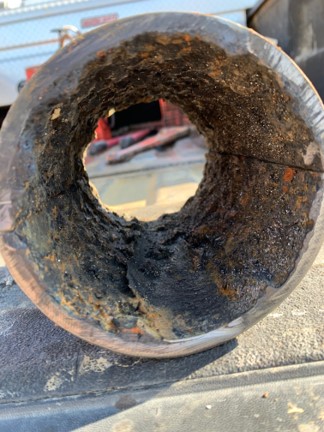
The corrosion allowance is typically specified by engineers and designers based on the expected lifespan of the structure or component, the corrosivity of the environment, and the type of material used. The amount of corrosion allowance required can vary widely depending on these factors, but it is generally specified as a percentage of the original material thickness.
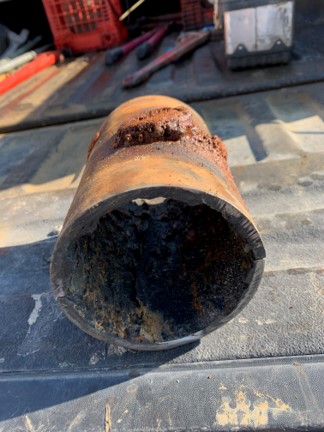 In all piping systems, the expected corrosion rate may be constant or change with time. External corrosion (atmospheric corrosion, dampness in the soil, or chlorides from insulation) may be a factor. Many companies usually specify a 1/16-inch (0.0625") minimum corrosion allowance for carbon steel and low alloy steel piping if the corrosion rate can be predicted accurately and is less than a defined threshold (3 mils per year or less as an example). For stainless steel, a 1/32-inch (0.0 3125") minimum corrosion allowance is usually sufficient.
Corrosion allowance is an important consideration in the design and maintenance of structures and components that are exposed to corrosive environments. By adding extra material to compensate for the loss of material due to corrosion, engineers and designers can help ensure that the structure or component will last for its intended lifespan without failure due to corrosion.
Factors to Consider When Determining the Corrosion Allowance
Corrosion Allowance Standards
- ASME B31G - Manual for Determining the Remaining Strength of Corroded Pipelines