
Compressor
Gas, Petroleum, Refinery, Compressor, Glossary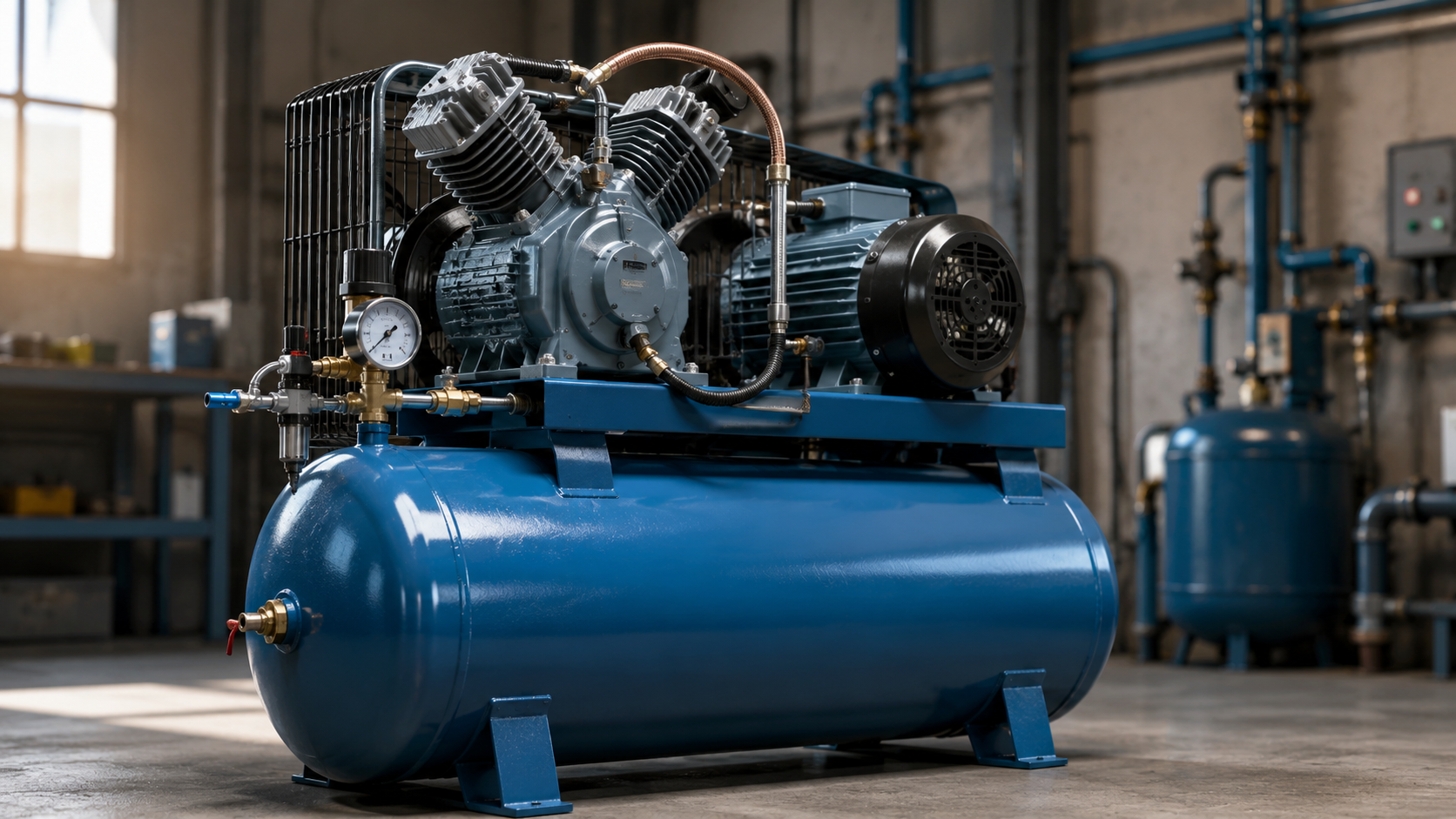 Compressor, abbreviated as \(COMPR\), is a mechanical machine that increases the pressure of a gas by reducing its volume. A compressor takes in a gas, such as air, natural gas, refrigerant vapor, hydrogen, nitrogen, or other gases and applies mechanical work to force the gas into a smaller space. As the gas is compressed, its pressure increases and, in most cases, its temperature also rises. This process allows the gas to be stored, transported, or used to perform useful work in industrial, commercial, and residential systems. Compressors are components in many engineering applications. They are used in air compression systems, refrigeration and air-conditioning equipment, gas pipelines, natural gas processing facilities, power generation plants, and numerous other industrial processes. The compressed gas produced by a compressor can be used for powering pneumatic tools, operating control systems, transporting gases through pipelines, supporting combustion processes, and circulating refrigerants in cooling systems.
From an engineering perspective, a compressor is an energy conversion device. It receives mechanical energy from a driver such as an electric motor, steam turbine, gas turbine, diesel engine, or internal combustion engine. The compressor converts this mechanical energy into pressure energy and internal energy within the gas. Because gases are compressible fluids, increasing their pressure requires work to be done on them. The amount of work required depends on factors such as the gas properties, inlet pressure and temperature, flow rate, compression ratio, and compressor design.
| Science |
| Applied Science |
| Engineering |
| Mechanical Engineering |
| Manufacturing |
Unlike pumps, which are designed primarily for liquids, compressors are specifically designed for gases. The distinction is important because gases can be compressed significantly, whereas liquids are generally considered incompressible under normal operating conditions. As a result, the design principles, thermodynamics, and operating characteristics of compressors differ substantially from those of pumps.
Compressor Types
Dynamic Compressor
The gas is first accelerated to high velocity, and then it passed through a diffuser. The kinetic energy of the air is converted to pressure energy at the diffuser before it leaves through the outlet.
Axial Compressor - Used where continuous flow and large amount of air is required. There are a series of blades on a shaft, the shaft having a number rows. The number of rows is referenced as a 10 stage, 15 stage and so on. The shaft is inside a tapered housing which compresses the air as it flows through. As the blades turn the air is pulled in the front, being compressed tighter as it exits.
Centrifugal Compressor - Often used offshore for field gas compression and are often used in gas plant applications. These are used when there is limited space available, when vibrations could be a problem (offshore) or a low weight to horsepower ratio is required.
Positive Displacement Compressor
Air is drawn into a chamber. The trapped air is then compressed, physically reducing the volume of the chamber.
- Reciprocating Compressor - Uses a crankshaft driven piston and cylinder to compress the air. Primarily used in field gas compression and have a very large range of capacity and horsepower characteristics.
- Single Acting - This compressor only have valves on top of the cylinder, so there is one compression cycle for every turn of the crankshaft.
- Double Acting - This compressor is similar to single-action, but they have inlet and discharge valves on both sides of the cylinder. This gives you two compression cycles for every turn of the crankshaft.
- Diaphragm - Compression of air is by the forward and backward movement of a crankshaft which brings about the movement of a special membrane inside the compression box. They are useful in processes where leaks through packing cannot be tolerated.
- Single Acting - This compressor only have valves on top of the cylinder, so there is one compression cycle for every turn of the crankshaft.
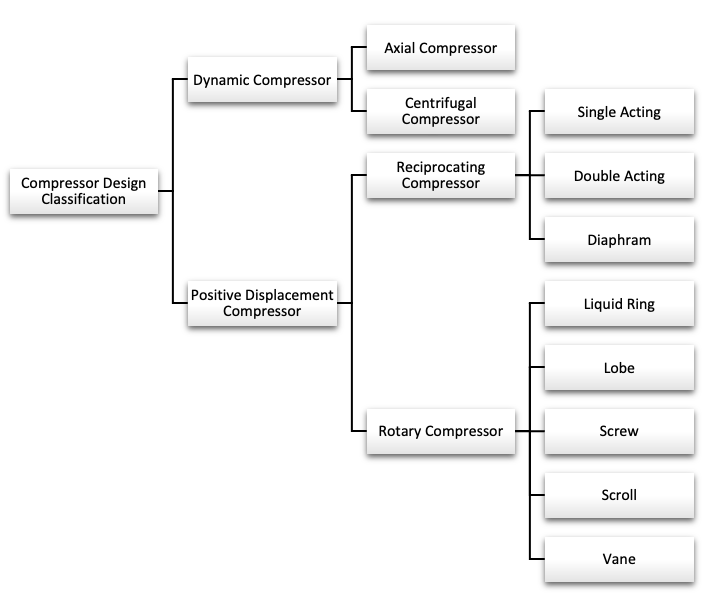 Rotary Compressor - Compression system that includes a pair of matching helical screws.
- Liquid Ring - An offset rotar is placed in a cylindrical housing and the liquid is fed into the housing. As the rotar spins, the water is thrown by centrifugal force to the outside. The void created in the center holds gas drawn in through the inlet port of the pump. As gas travels around the pocket of air in the center, it is compressed, then fed back out the discharge port.
- Lobe - They have two intermeshing rotors mounted on parallel shafts. In a twin-lobe compressor, each rotor has two lobes, four lobes per compressor. In a tri-lobe machine each rotor has three lobes, six lobes per compressor.
- Screw - The twin elements include male and female parts rotating in opposite directions. Air fills the space between the rotors and, as they rotate, the volume between them and the surrounding housing decreases, squeezing or compressing the air into a smaller space. The length, pitch of the screw, and the form of the discharge port collectively determine the pressure ratio.
- Scroll - Uses two interleaved spiral-like vanes to pump or compress the gas. One of the scrolls is fixed, while the other orbits eccentrically without rotating, thereby trapping and pumping or compressing pockets of gas between the scrolls. They operate more smoothly, quietly, and reliably than other types of compressors. These compressors are usually operated in the lower volume range.
- Vane - Often used in tank vapor recovery (TVR) operations. These compressors take gas at very low suction pressures and raise them to pressures required for gas sales. If they cannot get them to the high pressures, they will often discharge into another compressor that can.
- Liquid Ring - An offset rotar is placed in a cylindrical housing and the liquid is fed into the housing. As the rotar spins, the water is thrown by centrifugal force to the outside. The void created in the center holds gas drawn in through the inlet port of the pump. As gas travels around the pocket of air in the center, it is compressed, then fed back out the discharge port.