
Milky Way is the galaxy that contains the Solar System. A galaxy is a vast gravitationally bound system composed of stars, stellar remnants, interstellar gas, interstellar dust, and large amounts of dark matter. The Milky Way is classified as a barred spiral galaxy, meaning it has a central elongated bar of stars with spiral arms extending outward from the central region. The Sun and its planets are located within one of these spiral-arm structures, known as the Orion Arm, approximately 26,000 light-years from the galaxy’s center.
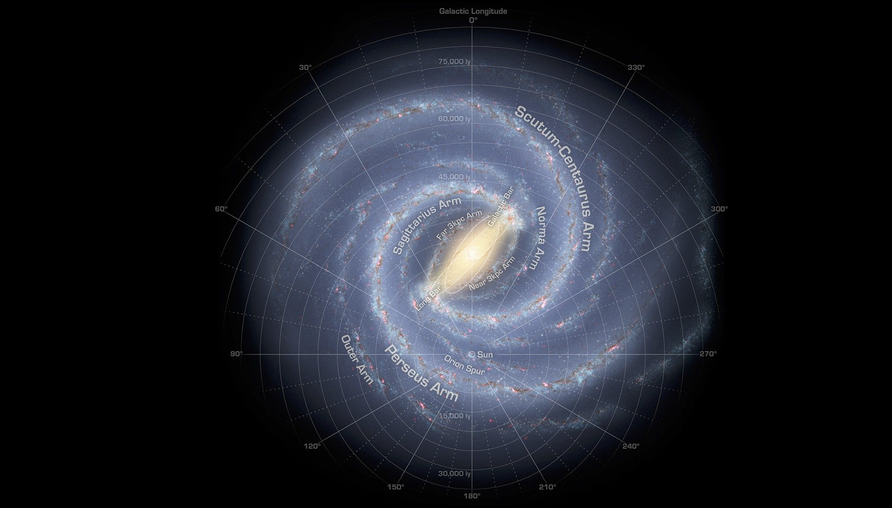 The term “Milky Way” refers both to the galaxy itself and to the diffuse band of light visible across the night sky from Earth. This luminous band is produced by the combined light of billions of distant stars within our galaxy. Because Earth lies inside the Milky Way, observers looking along the plane of the galaxy see a dense concentration of stars, gas, and dust that appears as a milky or cloudy streak stretching across the sky.
The Milky Way is enormous in scale. It contains hundreds of billions of stars and spans roughly 100,000 light-years or more in diameter. At its center lies a region of extremely high stellar density surrounding a supermassive black hole known as Sagittarius A*. The entire galaxy rotates, with stars, gas, dust, and the Solar System orbiting the galactic center under the influence of gravity. The Sun completes one orbit around the center of the Milky Way in approximately 225 to 250 million years, a period often called a galactic year.
The Milky Way is only one galaxy among the vast population of galaxies in the observable universe. It belongs to a gravitationally bound collection of galaxies called the Local Group, which includes the neighboring Andromeda Galaxy and numerous smaller galaxies. Current scientific evidence indicates that the Milky Way formed through a combination of star formation and mergers with smaller galaxies over billions of years, a process that continues to shape its structure today.
Milkey Way Rotation
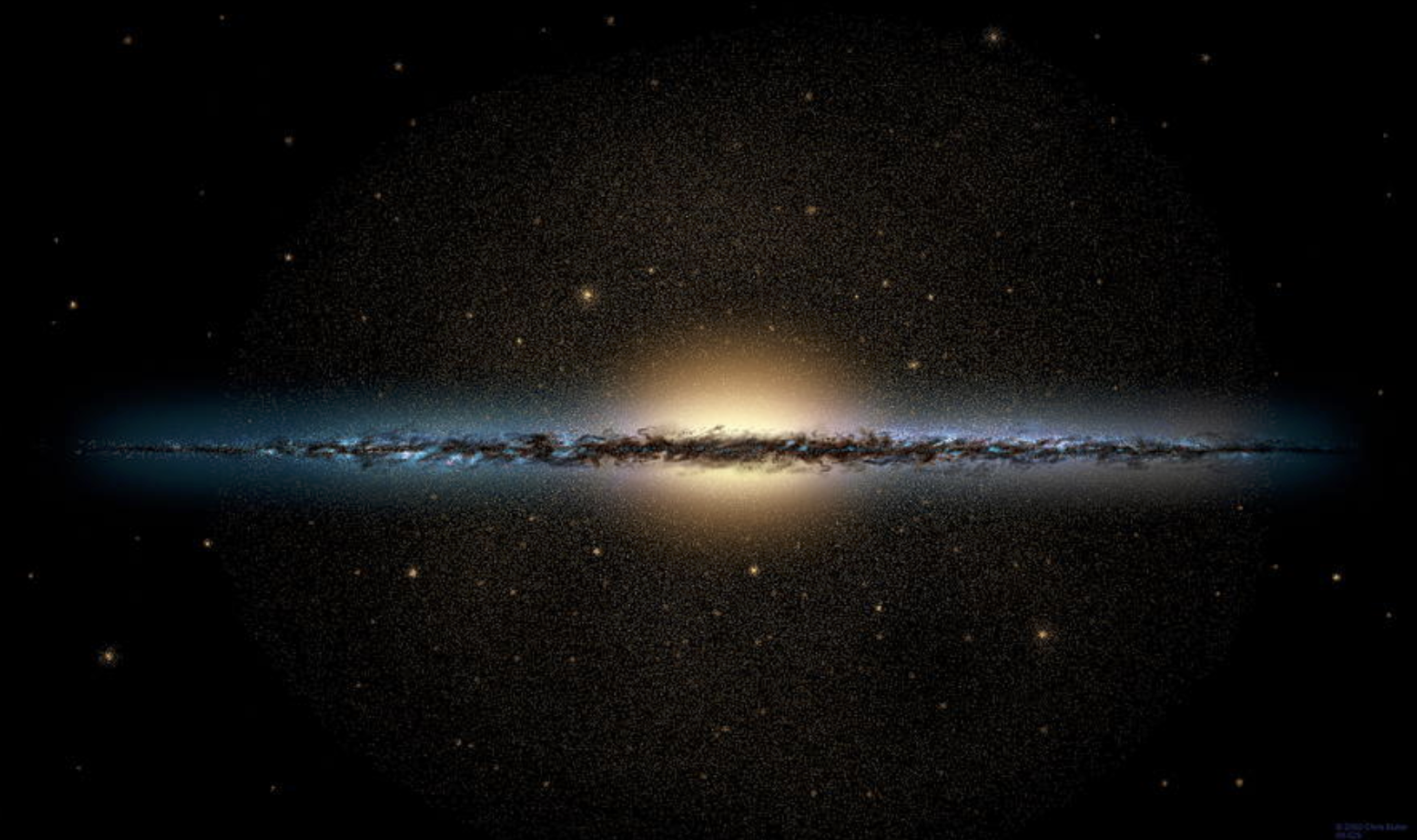 The Milky Way galaxy rotates as a flattened disk of stars, gas, and dust around a central axis, exhibiting differential rotation. Stars and interstellar material in the galactic disk follow nearly circular orbits in the same overall direction around the galactic center, which lies in the direction of the constellation Sagittarius. This rotation flattens the galaxy into its characteristic disk shape, as centrifugal forces balance gravitational attraction. Unlike a rigid body such as a solid disk or planet where all parts share the same angular velocity, the Milky Way rotates differentially. That means material closer to the center generally completes orbits in less time than material farther out, though the orbital speeds remain roughly constant across much of the disk rather than declining as predicted by Keplerian motion based solely on visible mass.
At the Sun's position, approximately 8 kiloparsecs (about 26,000 light-years) from the galactic center, the orbital speed is around 220–240 km/s. This corresponds to the Sun completing one full orbit around the galactic center roughly every 225–250 million years. Inner stars orbit faster in terms of angular speed, while outer stars lag behind due to their greater distances despite similar linear speeds.
When viewed from above the north galactic pole, looking down onto the galactic plane, the Milky Way's disk rotates clockwise. This direction is determined from the observed motions of stars and gas relative to the galactic center. No single, uniform rotation period applies to the entire galaxy due to differential rotation, though the solar neighborhood's orbital period serves as a common reference. Spiral arms are density waves that rotate more slowly than the material within them. All information derives from established astronomical observations and consensus in peer-reviewed literature; details like exact values continue to be refined with new data but the core description of differential, approximately flat rotation in the disk holds as verifiable fact.
Milkey Way Assumptions
Namesake - The Milky Way is the galaxy that contains the Solar System. The name "Milky Way" comes from its appearance as a faint, milky band of light stretching across Earth's night sky.
Type of Galaxy - The Milky Way is classified as a barred spiral galaxy. It contains a central bar-shaped concentration of stars, from which spiral arms extend outward.
Location of Earth - Earth is located within the Solar System, which lies in the Orion Arm (also called the Orion Spur), a minor spiral arm between the Sagittarius and Perseus Arms.
Distance from Galactic Center - The Solar System is approximately 26,000 light-years from the center of the Milky Way.
Diameter (Size) - The Milky Way's stellar disk is approximately 100,000 to 120,000 light-years in diameter. Some studies indicate that the galaxy's outer structures may extend farther, but the exact boundary is not sharply defined.
Thickness - The main stellar disk is approximately 1,000 light-years thick near the Solar System, while the central bulge is much thicker.
Galactic Rotation - The Milky Way rotates. Stars, gas, dust, and other objects orbit the galactic center due to gravity. Different parts of the galaxy rotate at different speeds.
Solar System Orbit Around the Galaxy:
- The Solar System travels around the Milky Way's center.
- Orbital speed: approximately 220 kilometers per second (137 miles per second).
- One complete orbit, often called a "galactic year," takes approximately 225–250 million Earth years.