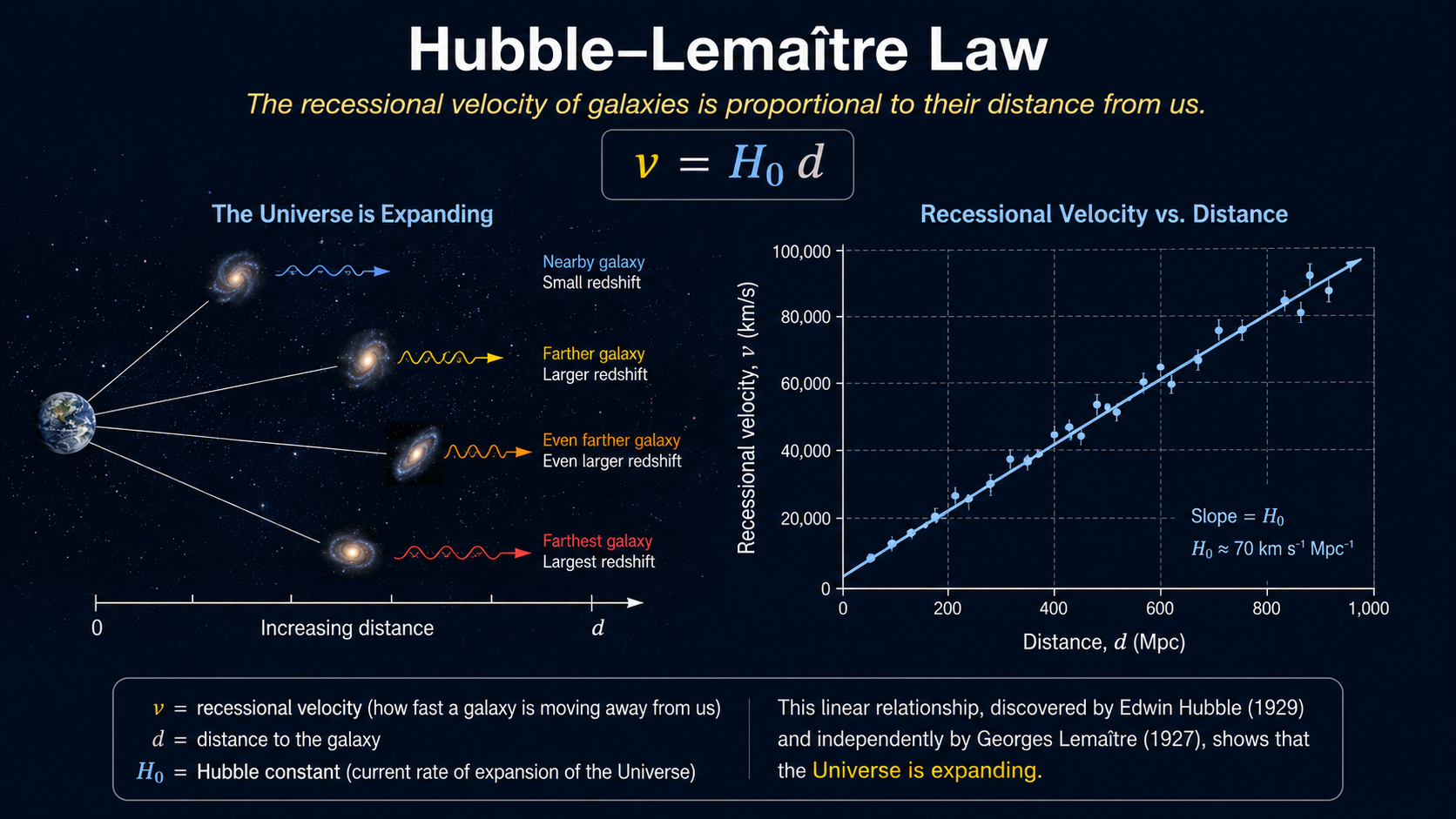
Hubble–Lemaître law, also called Hubble's Law, is the observation that galaxies are moving away from Earth at speeds proportional to their distance. It describes the expansion of the universe, where the recessional velocity of galaxies increases with greater distance from the observer. The law applies on large cosmological scales, where the dominant motion is due to the uniform expansion of space itself, known as the Hubble flow, rather than local gravitational effects. The linear relationship holds as a good approximation for relatively nearby galaxies, with more complex cosmological models accounting for deviations at greater distances due to the universe's changing expansion history. The Hubble constant represents the current expansion rate of the universe. While it is constant at any given cosmic time, the broader Hubble parameter varies over time as the universe evolves.
Hubble–Lemaître Law Formula |
||
|
\( v \;=\; H_0 \cdot d \) (Hubble's Law) \( H_0 \;=\; \dfrac { v }{ d } \) \( d \;=\; \dfrac{ v }{ H_0 } \) |
||
| Symbol | English | Metric |
| \( v \) = Velocity of the Galaxy | - | \(km \;/\; s\) |
| \( H_0 \) = Hubble Constant, which Represents the Current Rate of Expansion of the Universe | - | \( km \;/\; s \;/\; Mpc\) |
| \( d \) = Distance from the Galaxy to Earth | - | \(Mpc\) |