The universe is organized in a structure of gravitational systems and large scale patterns. At the smallest relevant scale in this context, the Sun is a star. The Sun anchors the Solar System, a gravitationally bound collection that includes planets, dwarf planets, moons, asteroids, comets, and other debris orbiting it.
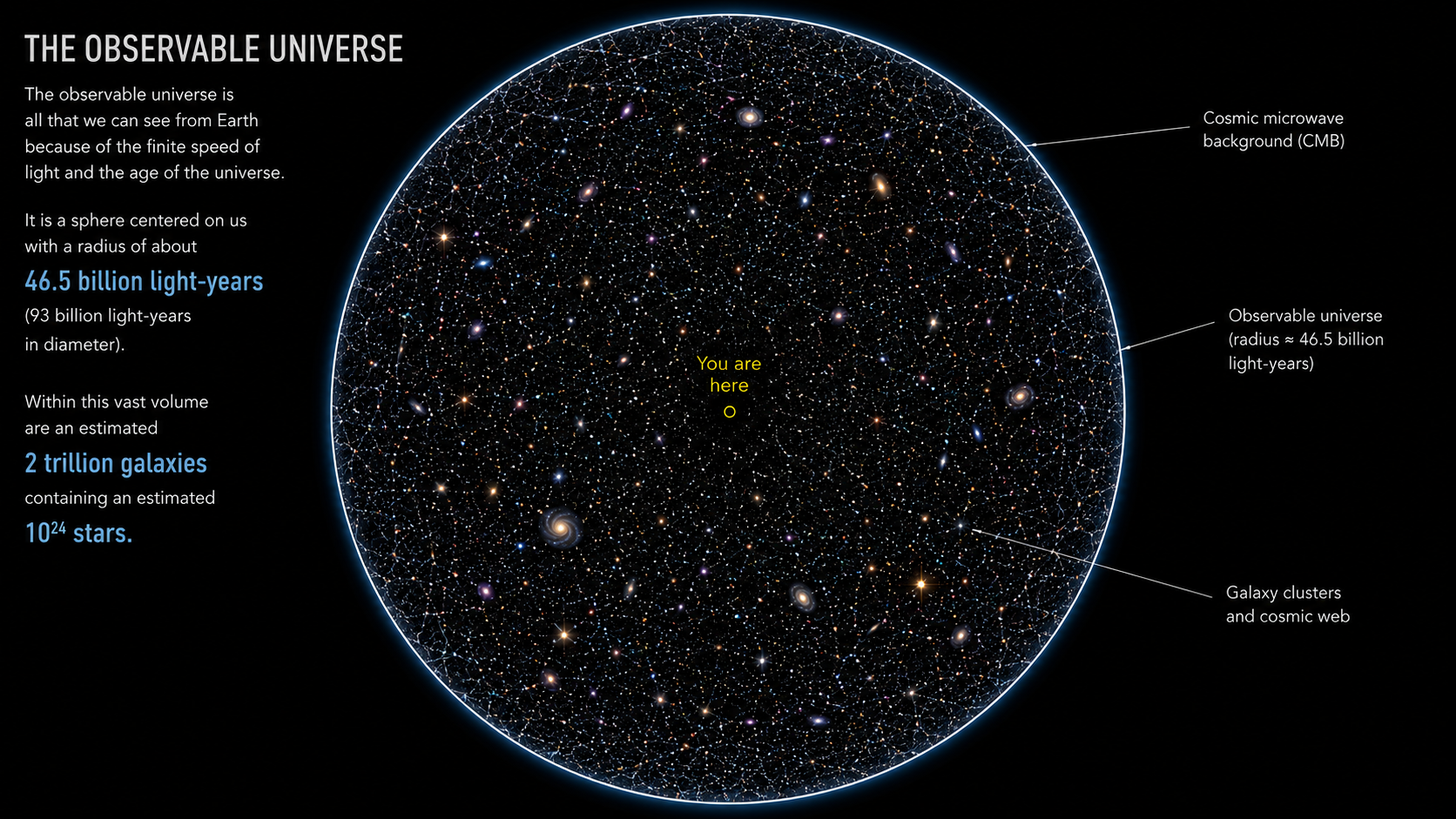 On the largest observable scales, galaxies, clusters, and superclusters are arranged into structures, interconnected in what is termed the cosmic web, with vast voids separating these concentrations. The entire arrangement is encompassed within the observable universe, the spherical volume centered on Earth from which light has had time to reach us since the Big Bang, extending approximately 46 billion light-years in radius.
Beyond the observable universe, the full extent and organization of the universe as a whole cannot be directly verified with current observations.
Solar System - The smallst commonly recognized astronomical system in this sequence. It consists of the Sun, eight planets, dwarf planets, moons, asteroids, comets, and other objects gravitationally bound to the Sun.
Milky Way - The galaxy containing the Solar System, with hundreds of billions of stars and associated structures.
Local Group - A galaxy group containing the Milky Way, Andromeda, Triangulum, and dozens of smaller galaxies.
Virgo Cluster - The Local Group lies on the outskirts of this large cluster of galaxies.
Virgo Supercluster - Historically used to describe the larger-scale structure containing the Local Group and Virgo Cluster.
Laniakea Supercluster - The recognized supercluster containing the Milky Way, Local Group, and Virgo Cluster.
Observable Universe - The largest directly observable structure. It encompasses all matter and radiation from which light has had sufficient time to reach Earth since the beginning of cosmic expansion. Its diameter is approximately 93 billion light-years.
Universe - The total of all space, time, matter, energy, and physical laws. Whether the Universe is finite or infinite in extent is unknown. Because its full size has not been observationally determined, an exact dimension is not known.