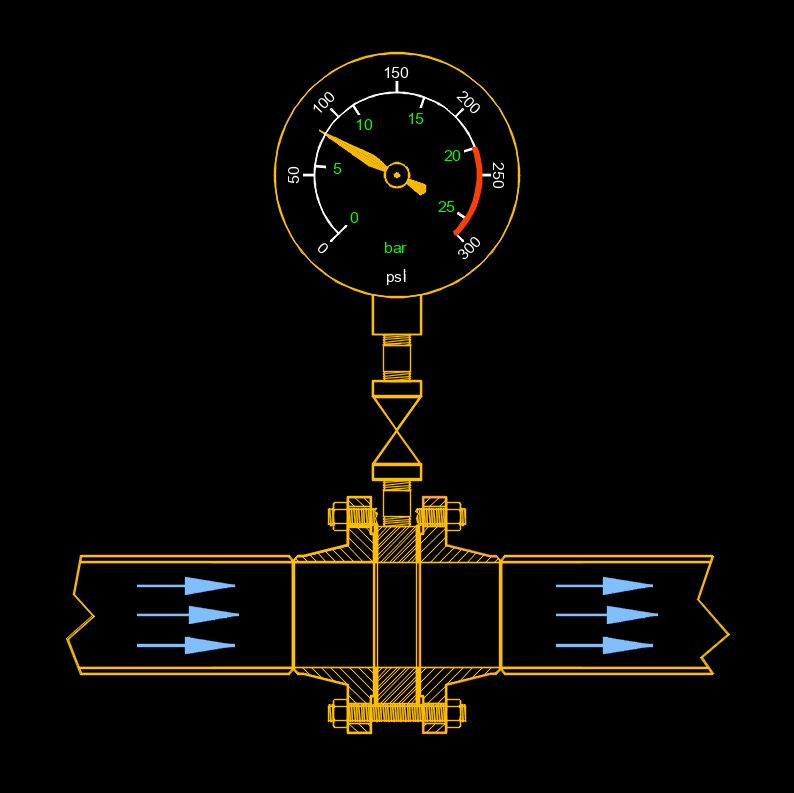
Working pressure, abbreviated as \(WP\), is the maximum internal or external pressure at which a component, vessel, pipe, hose, or system is designed to operate safely under specified service conditions. It is a design and rating parameter established by engineering analysis, material properties, fabrication method, and applicable codes and standards. In pressure containing equipment, working pressure defines the upper limit of continuous operation without exceeding allowable stresses or compromising structural integrity. In all cases, working pressure is a verifiable engineering parameter tied to material properties, design equations, and code compliance. It is not necessarily equal to normal operating pressure, rather, it represents the maximum permissible pressure for safe operation under defined conditions.
 In pressure vessels, the term is closely associated with maximum allowable working pressure \((MAWP)\), as defined in the ASME Boiler and Pressure Vessel Code. \(MAWP\) is the maximum gauge pressure permissible at the top of a completed vessel in its normal operating position at a specified temperature. It is determined based on the weakest element of the vessel, considering material strength at design temperature, wall thickness, joint efficiency, corrosion allowance, and geometric configuration. The \(MAWP\) is not an arbitrary number; it is calculated using established stress formulas and safety factors prescribed by the governing code.
In piping systems, working pressure similarly is the maximum pressure at which the piping component is rated to operate continuously. Standards such as ASME B31.3 define allowable stress limits and design pressure criteria for process piping. The working pressure rating must account for internal pressure, temperature effects on material strength, and any additional loads that contribute to stress in the system.
For flexible components such as hoses and fittings, manufacturers specify a rated working pressure that is typically lower than the burst pressure. The burst pressure is the pressure at which failure occurs under controlled test conditions, while the working pressure incorporates a safety factor relative to burst strength to ensure safe service life.