Fluid Dynamics
Fluid Dynamics, Fluid MechanicsFluid dynamics is the branch of fluid mechanics that studies the motion of fluids, both liquids and gases, and the forces and effects associated with that motion. The field describes how fluids behave under various conditions, including flow patterns, pressure distributions, viscosity effects, and interactions with solid boundaries. These descriptions are typically expressed through mathematical models, most notably the Navier-Stokes equations, which are derived from Newton's laws of motion applied to a continuous medium.
Fluid dynamics distinguishes itself from fluid statics, which concerns fluids at rest, by focusing on scenarios where velocity, acceleration, and time-dependent changes occur. It encompasses both theoretical analysis and experimental methods, often employing dimensionless numbers like the Reynolds number (to characterize laminar versus turbulent flow), Mach number (for compressibility effects), and Froude number (for gravity waves) to scale and predict behavior across different systems.
| Science |
| Natural Science |
| Physics |
| Fluid Mechanics |
| Fluid Dynamics |
Applications of fluid dynamics including aerodynamics (aircraft and vehicle design), hydrodynamics (ship design and water flow), meteorology (weather patterns and atmospheric circulation), oceanography, blood flow in physiology, and industrial processes such as pipeline transport and chemical mixing.
Fluid Dynamics Branches
Fluid Classification
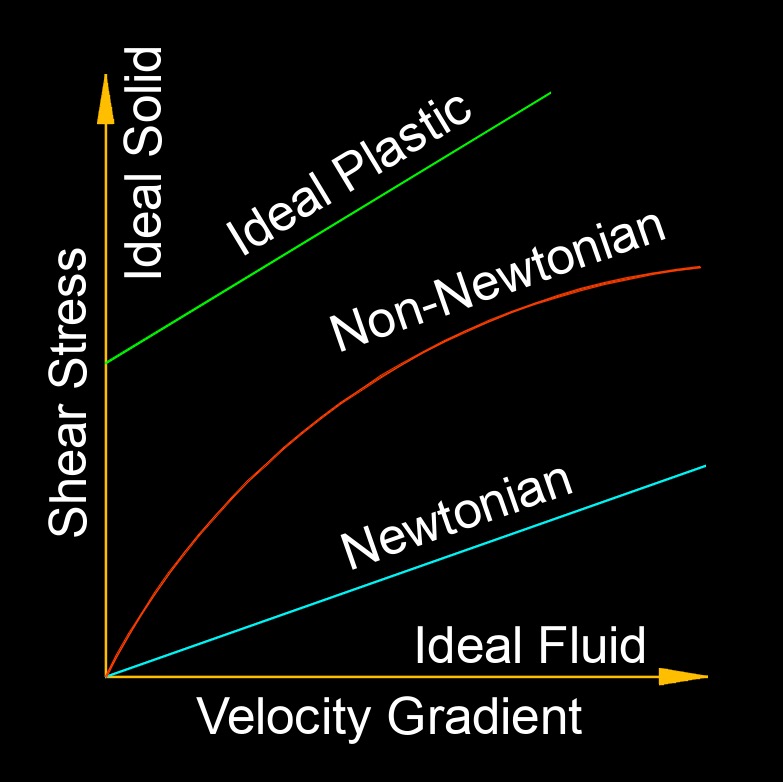 Ideal Fluid - It is incompressible and has no viscosity. Ideal fluid is only an imaginary fluid, as all the fluids known have some viscosity.