
Terrestrial planet is a class of planet that is composed primarily of silicate rocks or metals and has a solid surface. Within our Solar System, there are four inner planets recognized as terrestrial planets, Mercury, Venus, Earth, and Mars. These planets formed closer to the Sun, where higher temperatures favored the condensation of rocky materials over volatile gases. They are distinguished from the outer gas giants (Jupiter and Saturn) and ice giants (Uranus and Neptune), by their smaller sizes, higher densities, and rocky makeup, which includes a metallic core (primarily iron), a silicate mantle, and a solid crust.
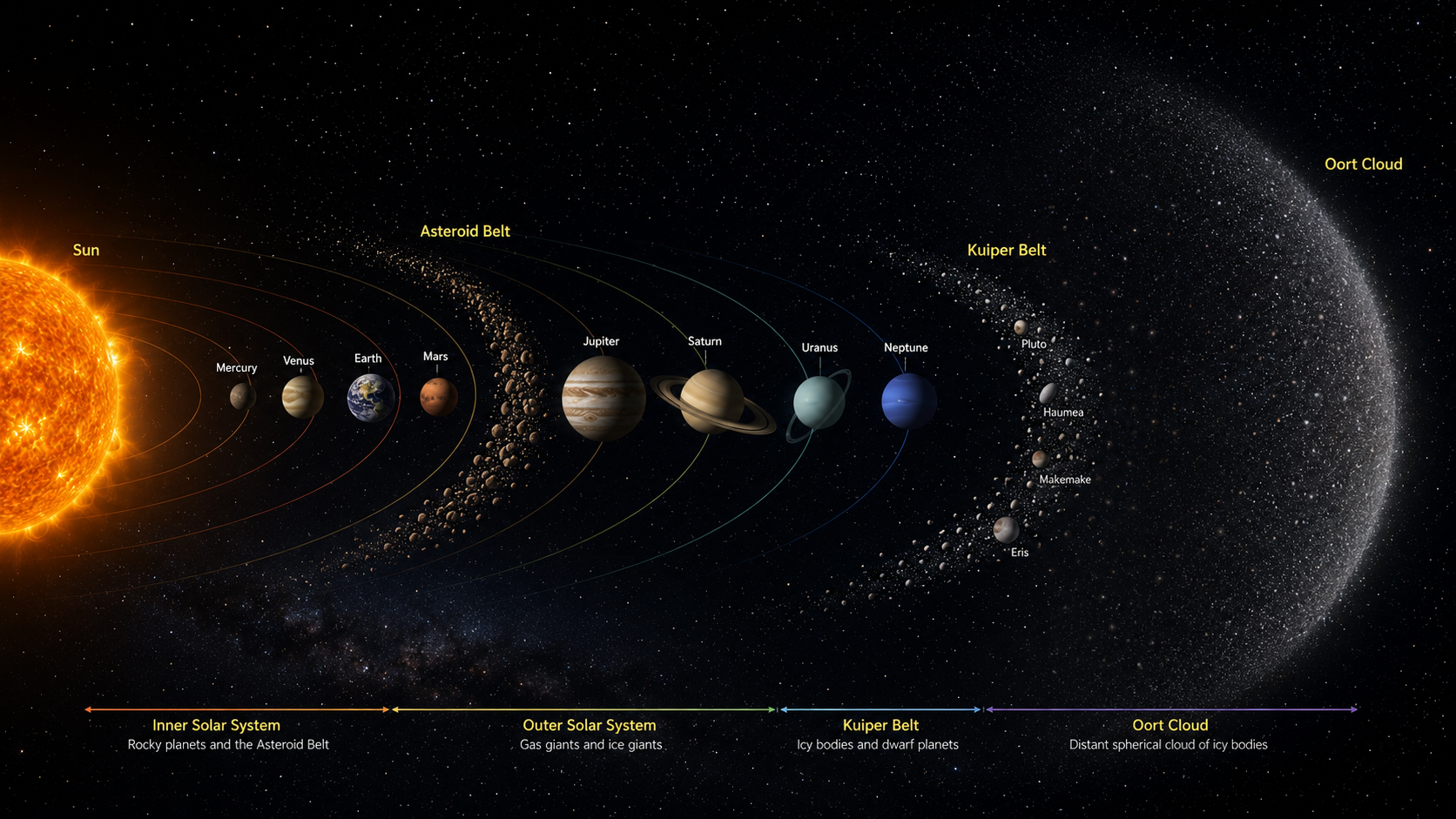 Terrestrial planets generally feature a bulk composition dominated by rock or iron, along with a solid or liquid surface. They may possess atmospheres of varying thickness, ranging from the negligible atmosphere of Mercury to the dense carbon dioxide atmosphere of Venus and the nitrogen-oxygen atmosphere of Earth. They can also exhibit geological features such as craters, volcanoes, valleys, and mountains shaped by impacts, tectonics, or erosion. For exoplanets beyond our Solar System, the term terrestrial is applied to rocky worlds roughly between half the size of Earth and up to about twice Earth's radius.