
Pulsar is a highly magnetized, rapidly rotating neutron star that emits beams of electromagnetic radiation from its magnetic poles. Neutron stars form as the collapsed cores of massive stars (typically more than about 8-10 times the mass of the Sun) that have undergone a supernova explosion. In these remnants, the core is compressed to extreme densities, roughly the mass of the Sun squeezed into a sphere about 10-20 kilometers in diameter, where protons and electrons combine to form neutrons, resulting in matter composed almost entirely of neutrons.
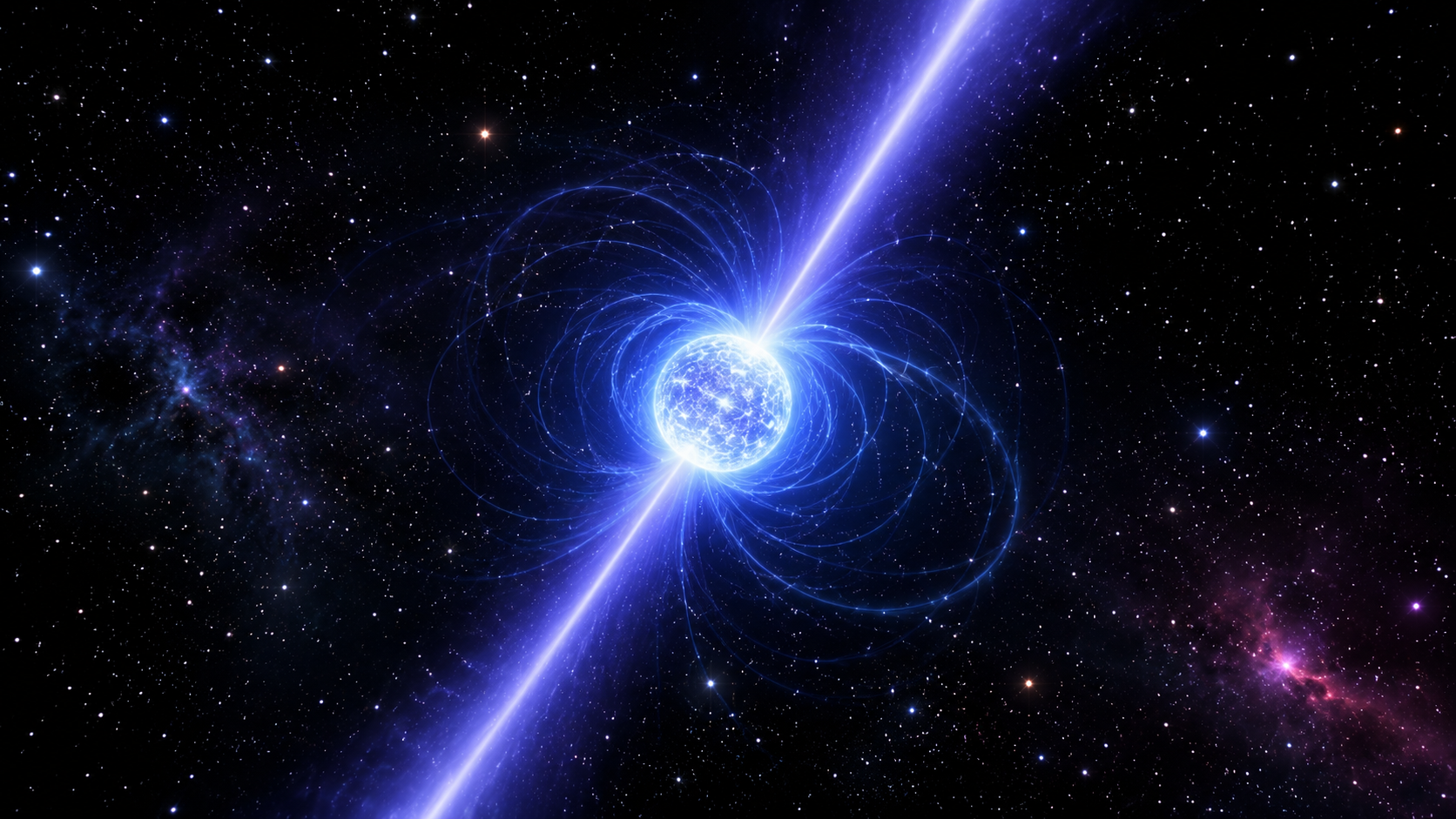 The pulsing effect arises because the neutron star's strong magnetic field (often trillions to quadrillions of times stronger than Earth's) accelerates charged particles along the magnetic poles, producing beams of radiation, primarily radio waves, but also in X-rays, gamma rays, and sometimes visible light. These beams are not aligned with the star's rotation axis. As the neutron star spins (with periods ranging from milliseconds to seconds), the beams sweep through space like a lighthouse. When one of the beams crosses Earth's line of sight, observers detect a pulse of radiation. The rotation periods are highly stable due to the immense angular momentum of the compact object, making some pulsars among the most precise natural clocks known.
Pulsars are typically observed as radio pulsars, but some emit across multiple wavelengths. Their rotation slows over time as they lose energy through electromagnetic radiation and particle emission, with characteristic ages estimated from this spin-down rate. Millisecond pulsars, which rotate hundreds of times per second, are often older objects that have been spun up by accreting material from a companion star in a binary system. Over 3,000 pulsars have been cataloged, many associated with supernova remnants.