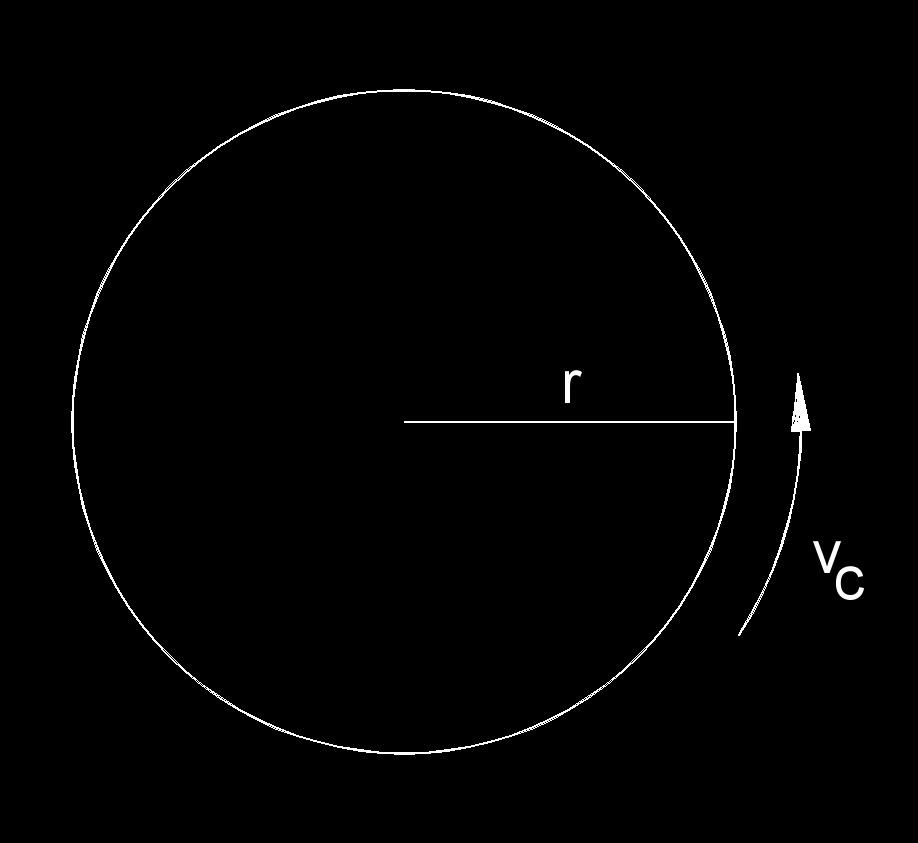
Circular velocity, abbreviated as vc is the velocity at which an object moves around a circle with a given radius. It shows that the velocity of an object moving in a circular path is directly proportional to the radius of the path and the frequency of revolution, which is the reciprocal of the time for one complete revolution.
Circular Velocity Formula |
||
|
\( v_c \;=\; \dfrac{ 2 \cdot \pi \cdot r }{ t } \) (Circular Velocity) \( r \;=\; \dfrac{ v_c \cdot t }{ 2 \cdot \pi }\) \( t \;=\; \dfrac{ 2 \cdot \pi \cdot r }{ v_c } \) |
||
| Symbol | English | Metric |
| \( v_c \) = Circular Velocity | \(ft\;/\;sec\) | \(m\;/\;s\) |
| \( \pi \) = Pi | \(3.141 592 653 ...\) | \(3.141 592 653 ...\) |
| \( r \) = Circular Path Radius | \(ft\) | \(m\) |
| \( t \) = One Complete Revolution Time | \(sec\) | \(s\) |
 This is used in many fields of science and engineering, including physics, astronomy, and mechanics. Some examples are, the circular velocity of a planet orbiting a star can be calculated using the circular velocity formula, given the planet's distance from the star and the time it takes to complete one orbit. Also, the circular velocity of a car driving around a banked curve can be calculated using the formula, given the radius of the curve and the coefficient of friction between the tires and the road.

Circular Velocity Formula |
||
|
\( v_c \;=\; \omega \cdot r \) (Circular Velocity) \( \omega \;=\; \dfrac{ v_c }{ r } \) \( r \;=\; \dfrac{ v_c }{ \omega }\) |
||
| Symbol | English | Metric |
| \( v_c \) = Circular Velocity | \(ft\;/\;sec\) | \(m\;/\;s\) |
| \( \omega \) (Greek symbol omega) = Angular Velocity | \(deg\;/\;sec\) | \(rad\;/\;s\) |
| \( r \) = Circular Path Radius | \(ft\) | \(m\) |