Strain energy, abbreviated as \(U\), is the energy stored within a material when it is subjected to deformation or strain. It's a form of potential energy that arises due to the change in shape or configuration of a material when it's subjected to external forces. Strain energy is a concept commonly used in the field of mechanics and materials science to analyze the behavior of materials under mechanical loads.
Strain Energy formula |
||
|
\( U \;=\; \frac{ 1 }{ 2 } \cdot \dfrac{V}{E} \cdot \sigma^2 \) (Strain Energy) \( V \;=\; \dfrac{ 2 \cdot U \cdot E }{ \sigma^2 }\) \( E \;=\; \dfrac{ V \cdot \sigma^2 }{ 2 \cdot U }\) \( \sigma \;=\; \sqrt{ \dfrac{ 2 \cdot U \cdot E }{ V }} \) |
||
| Symbol | English | Metric |
| \( U \) = Strain Energy | \(lbf-ft\) | \(J\) |
| \( V \) = Volume | \(in^3\) | \(mm^3\) |
| \( E \) = Young's Modulus | \(lbf\;/\;in^2\) | \( Pa \) |
| \( \sigma \) (Greek symbol sigma) = Stress | \(lbf\;/\;in^2\) | \( Pa \) |
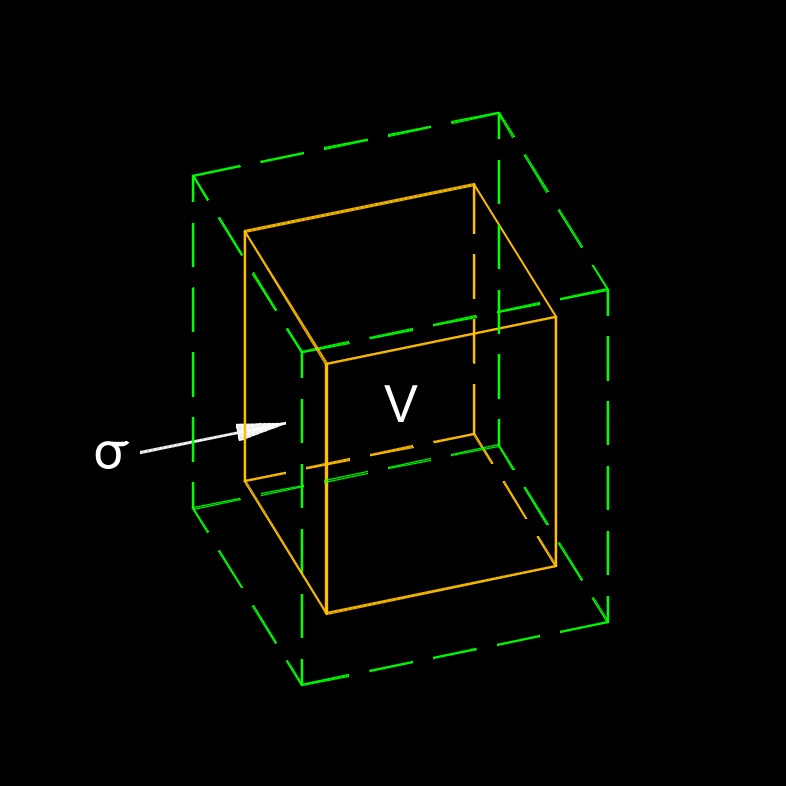
Strain energy is a concept in designing structures and mechanical components. Engineers consider strain energy when designing materials that need to withstand external loads without failing. By understanding how strain energy accumulates and dissipates within materials, engineers can make informed decisions about material selection, design, and safety.
Affect of Strain Energy on Molecules